


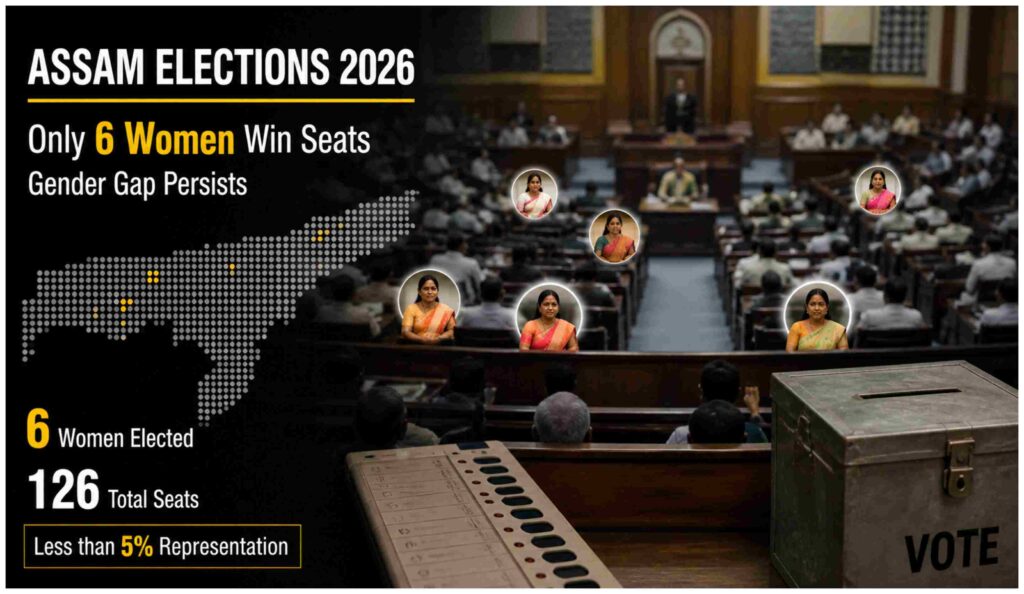
The results of the Assam Assembly elections 2026 have once again drawn attention to a stark imbalance in political representation, with women securing only a handful of seats in the 126-member House.
Out of all constituencies, just six elected women candidates—accounting for less than 5% of the total—underscoring the continuing gender gap in Assam’s electoral politics.
A closer look at the results shows that five of the six winners are from the ruling alliance led by the Bharatiya Janata Party, while the opposition managed to secure only one victory.
The NDA had fielded eight women candidates in total—six from the BJP and one each from the Asom Gana Parishad and the Bodoland People’s Front. In comparison, the opposition alliance nominated 11 women candidates, including nine from the Indian National Congress. Despite the higher number, only one opposition candidate emerged victorious.
Among the prominent winners, Sewli Mohilary of the BPF registered a commanding win in Kokrajhar, defeating UPPL’s Lawrence Islary by over 39,000 votes.
In Golaghat, senior BJP leader Ajanta Neog secured a decisive victory against Congress candidate Bitupan Saikia, winning by more than 43,000 votes.
Nilima Devi clinched Mangaldoi for the BJP with a margin of nearly 24,000 votes over Congress’ Rijumoni Talukdar.
A standout result came from Haflong, where BJP’s young candidate Rupali Langthasa defeated NPP’s Daniel Langthasa by a massive margin of close to 50,000 votes, with the Congress candidate finishing third.
In Bongaigaon, Diptimayee Choudhury secured victory by nearly 25,000 votes against Congress’ Girish Barua.
The lone opposition winner was Baby Begum from Dhubri, who recorded a landslide win over AIUDF’s Nazrul Haque by more than 68,000 votes.
The outcome once again highlights the limited presence of women in Assam’s legislative politics, raising broader questions about candidate selection, party priorities, and the need for stronger efforts toward gender inclusivity in the state’s electoral process.