


NABARD has published the findings from its second All India Rural Financial Inclusion Survey (NAFIS) for 2021-22, which offers primary data based on a survey of 1 lakh rural households, covering various economic and financial indicators in the post-COVID period. Recognizing the vital role of financial inclusion for economic development, NABARD conducted the inaugural survey for the agricultural year (July-June) 2016-17, with results released in August 2018. Since then, the economy has faced numerous challenges, and policies have been implemented to support agriculture and boost rural socio-economic progress. The NAFIS 2021-22 results could help to shed light on how rural economic and financial development indicators have evolved since 2016-17. The survey included all 28 states and the Union Territories of Jammu & Kashmir and Ladakh.
Strengthening Rural Population: Insights from the NAFIS 2021-22
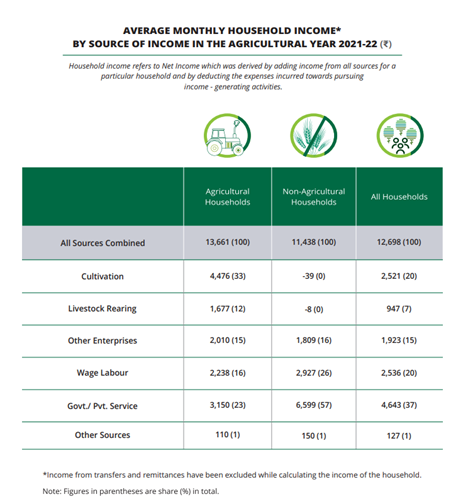
- Increase in Average Monthly Income: The average monthly income of households saw a substantial rise of 57.6% over a five-year period, increasing from Rs. 8,059 in 2016-17 to Rs. 12,698 in 2021-22. This indicates a nominal compound annual growth rate (CAGR) of 9.5%. Annual average nominal GDP growth during the same period (on financial year basis) was 9%. When considering all households together, the average monthly income stood at Rs. 12,698, with agricultural households earning slightly more at Rs.13,661, compared to Rs. 11,438 for non-agricultural households. Salaried employment in the government or private sector was the largest income source for all households, accounting for approximately 37% of their total income. For agricultural households, cultivation was the main income source, making up about one-third of their monthly earnings, followed by government or private services contributing one-fourth share, wage labor (16%), and other enterprises (15%). Among the non-agricultural ones, it was the Government/ private service which contributed 57% of the total household income, followed by wage labour which made up for roughly 26% of the total income.

- Rise in Average Monthly Expenditure: The average monthly expenditure of rural households rose significantly from Rs. 6,646 in 2016-17 to Rs. 11,262 in 2021-22. The agricultural households reported a relatively higher consumption expenditure of Rs. 11,710 than Rs. 10,675 for non-agricultural households. In states like Goa and Jammu & Kashmir, the monthly household expenditure exceeded Rs. 17,000. Overall, agricultural households demonstrated both higher income and expenditure levels than non-agricultural households.
- Increase in Financial Savings: The annual average financial savings of households increased to Rs. 13,209 in 2021-22 from Rs. 9,104 in 2016-17. Overall, 66% of households reported saving money in 2021-22, compared to 50.6% in 2016-17. Agricultural households outperformed non-agricultural ones in terms of savings, with 71% of agricultural households reporting savings during the reference period, compared to 58% of non-agricultural households. In 11 states, 70% or more households saved money, with Uttarakhand (93%), Uttar Pradesh (84%), and Jharkhand (83%) leading. In contrast, states like Goa (29%), Kerala (35%), Mizoram (35%), Gujarat (37%), Maharashtra (40%), and Tripura (46%) saw less than half of households reporting savings.
- Kisan Credit Card (KCC): The Kisan Credit Card (KCC) has emerged as a key tool for promoting financial inclusion in the rural agricultural sector, showing substantial growth in coverage over the past five years. In total, 44% of agricultural households were found to possess a valid Kisan Credit Card (KCC). Among those with land holdings greater than 0.4 hectares or those who had taken any agricultural loans from banks in the past year, 77% reported having a valid KCC.
- Insurance Coverage: The percentage of households with at least one member covered by any form of insurance increased significantly from 25.5% in 2016-17 to 80.3% in 2021-22. This means that four out of every five households had at least one insured member. Agricultural households outperformed their non-agricultural counterparts by a margin of roughly 13 percentage points. Among different types of insurance, vehicle insurance was the most prevalent, with 55% of households covered. Life insurance coverage extended to 24% of households, with agricultural households showing slightly higher penetration (26%) compared to non-agricultural ones (20%).
- Pension Coverage: Pensions significantly enhance recipients’ quality of life by offering financial support and reducing dependency on others, thereby boosting their self-worth and confidence. The percentage of households with at least one member receiving any form of pension (such as old age, family, retirement, or disability) increased from 18.9% in 2016-17 to 23.5% in 2021-22. Overall, 54% of households with at least one member over 60 years old reported receiving it, highlighting the importance of pensions in supporting elderly members of society.
- Financial Literacy: The percentage of respondents demonstrating good financial literacy increased by 17 percentage points, rising from 33.9% in 2016-17 to 51.3% in 2021-22. The proportion of individuals exhibiting sound financial behavior- such as managing money effectively, making informed financial decisions, tracking expenses, and paying bills on time—also increased from 56.4% to 72.8% during the same period. When assessed on financial knowledge, 58% of respondents from rural areas and 66% from semi-urban areas answered all questions correctly.
Conclusion
The NAFIS 2021-22 results highlight the remarkable strides made in rural financial inclusion since the last survey in 2016-17. Rural households have experienced notable improvements in income, savings, insurance coverage, and financial literacy. The Government welfare schemes like Pradhan Mantri Kisan Samman Nidhi, Pradhan Mantri Kisan MaanDhan Yojana, Mahatma Gandhi National Rural Employment Guarantee Scheme (MGNREGS), Pradhan Mantri Awas Yojana-Gramin (PMAY-G), Pradhan Mantri Gram Sadak Yojana (PMGSY), Deendayal Antyodaya Yojana- National Rural Livelihoods Mission (DAY NRLM), Deendayal Upadhyaya Grameen Kaushalya Yojana (DDU-GKY) have significantly contributed to improving the lives of the rural population. As access to financial services continues to expand, there is a bright outlook for the economic empowerment of these households. The survey underscores the importance of ongoing support and investment in rural development, paving the way for a more prosperous and financially secure future for India’s rural population.