


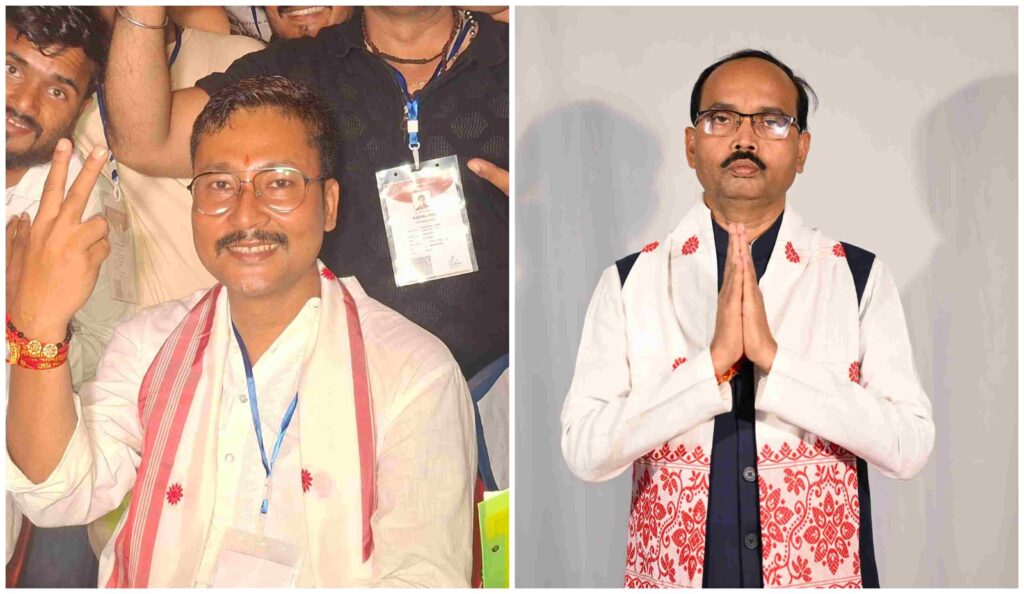
In politics, timing can matter as much as ideology—and the 2026 Assam Assembly elections 2026 offer a clear illustration of that reality.
Few results highlight this better than the victories of Prakash Chandra Das and Jibesh Roy—two leaders whose last-minute political shifts have carried them into the Assam Legislative Assembly for the first time.
Both won by narrow margins, yet their victories underscore a broader trend: in Assam’s evolving political landscape, strategic alignment and timing can outweigh long-held ideological positions.
From Student Firebrand to Electoral Pragmatist
Contesting as an Asom Gana Parishad candidate from Hajo-Sualkuchi, Das defeated Nandita Das by just 724 votes, polling 81,699 against her 80,975.
A former leader of the All Assam Students’ Union, Das was a prominent face of the anti-CAA movement, long associated with identity-driven regional politics. His exit from AASU surprised many—but what followed marked a sharper turn.
Das joined the Bharatiya Janata Party, signalling a shift toward national politics. However, when the BJP allotted the seat to its ally AGP under a seat-sharing arrangement, his electoral prospects dimmed.
In a swift recalibration, Das left the BJP, joined the AGP, and secured the party ticket. The gamble paid off: a razor-thin victory and a seat in the Assembly—highlighting how adaptability can shape political success.
Jibesh Roy: The Strategic Leap
A similar trajectory unfolded in Bilasipara, where Roy, also contesting on an AGP ticket, defeated Amrit Badsha by 2,694 votes, securing 85,937 against 83,243.
Roy began his political career in the Kamtapur Autonomous Council, eventually rising to become its Chief Executive Member. While influential at the regional level, his ambitions extended to the Assembly.
Recognising the electoral realities in Bilasipara—and the BJP’s decision to cede the seat to the AGP—Roy made a decisive move. Just a day before ticket distribution, he left the BJP and joined the AGP, securing the nomination. Within days, that decision translated into an electoral win.
Strategy Over Ideology
The journeys of Das and Roy point to a recurring pattern in Assam’s coalition politics: electoral viability often takes precedence over ideological consistency.
Both leaders shifted allegiance when it became clear their prospects were stronger under the AGP banner. To critics, such moves may appear opportunistic; to supporters, they reflect political pragmatism.
Either way, the outcome is undeniable—both candidates converted opportunity into victory.
When Timing Meets Opportunity
Politics rewards those who can read the moment—and act on it. For Das and Roy, calculated risks turned into defining victories.
Their rise is not just a story of narrow wins, but of timing, strategy, and the ability to seize opportunity in a rapidly shifting political landscape.
In Assam’s coalition-era politics, fortune may favour the bold—but only when instinct aligns with calculation.