


by Muhammad Talha Amin Baruah
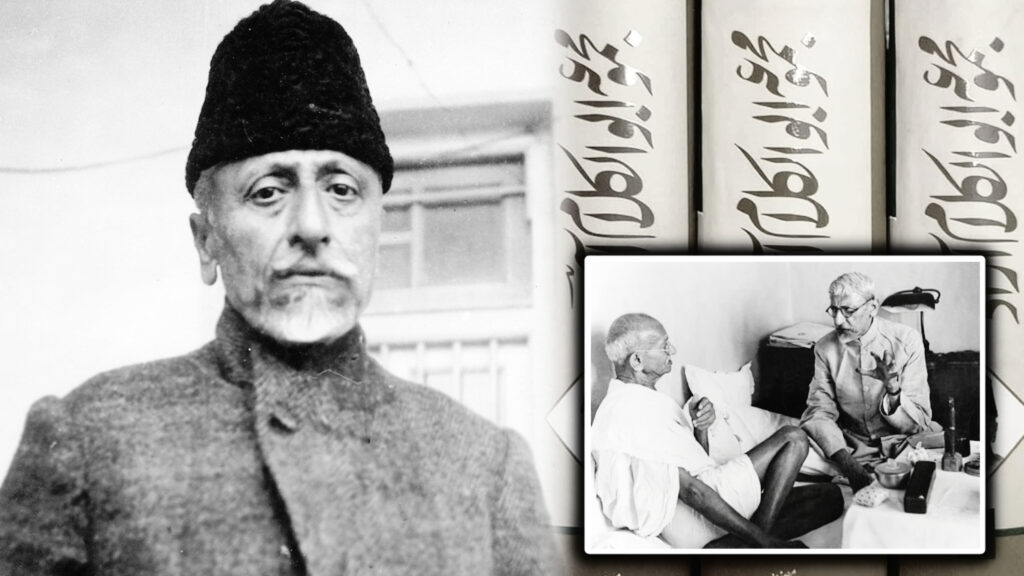
Abul Kalam Azad was born in Mecca and was an Indo-Arab, immersing him in the intellectual traditions of the Arab world from an early age. Drawing inspiration from Arab reformist thinkers and pan-Islamic movements, Azad became a prolific writer and journalist, launching influential Urdu journals to voice the concerns of independent Indian and advocate for unity. His exposure to the vibrant religious and political ideas circulating in the Arab world profoundly influenced his worldview, fueling his commitment to India’s independence. This article explores Azad’s remarkable journey and legacy, as seen through the lens of Arab sources.
Ahmad ibn Khairuddin (nicknamed Muhiyuddin) was the real name of Maulana Abul Kalam Azad. He was born in the year 1302 AH (1885 AD) or 1306 AH (1888 AD) at Mecca, Ottoman Arabia. Abul Kalam’s father was an inhabitant of Delhi and from there he migrated to Ottoman Arabia where Abul Kalam was born. Azad’s mother was an Arab. When Azad was three or five years old, his family returned back to India and settled at Calcutta. Azad continued his studies there. He adopted the word ‘Azad’ in his name to showcase his spirit of freedom. In 1908, Azad visited Ottoman Arabia and the Khedivate of Egypt. In Egypt, he studied under the scholars of Al Azhar university. When he returned to India, he established a magazine known as ‘Al Hilal’ in the Urdu language of 12th of June, 1912. The magazine served to ignite the spirit of freedom among Indian Muslims. The main purpose of this magazine was also to expose the British government. Because of this, he was arrested in 1914 at Ranji and the Al Hilal magazine was shut down. While in Prison he wrote an entire Tafsir (interpretation) of the Quran in 15 volumes in Urdu language since Azad was a prolific mufassir (Quran interpreter). Azad was influenced by the Ottoman scholars – Rashid Rida and Muhammad Abduh.
He was released from prison in 1920 and upon his return, he established a new magazine known as ‘Al Balagh’. He became a member of the Indian National Congress and hence the Britishers arrested him repeatedly acclaiming that he incited riots against the English government. Abul Kalam spent 11 years of his life in prison, even that didn’t stop him from his freedom activism. In prison he also composed in another work in urdu titled ‘Al Tazkirah’ in which he recorded his philosophical and political doctrine.
Abul Kalam was one of the most prominent muslim leaders of the freedom movement. He was the advisor of Pandit Jawaharlal Nehru. He was also the leader of the INC in 1923 as well as in 1939. He actively participated in the Khilafat movement in India. When India gained independence, Pakistan was formed. Azad chose to stay in India. He served as the president of the parliament, then the education minister, then the Natural resource and scientific research minister. Abul Kalam Azad was the first education minister of Independent India. He was sent as the Indian ambassador to Egypt, making him the first Indian to represent India in an Arab country. Also Azad became the second Indian ambassador to represent India internationally. Azad died in 1377 AH (1958 AD) due to paralysis.
Abul Kalam Azad was called the master of two imams i.e Imam of religion and Imam of politics. The Deobandi scholar Muhammad Tayyib Qasmi once mentioned Abul Kalam Azad’s meeting arrangements at Lucknow for education policy. Qasmi said that he was given the honour to give a speech and Azad praised him for it, Azad’s approving words are what Muhammad Tayyin recalls as unforgettable. Syed Sulayman Al Nadwi praised both of Abul Kalam Azad’s magazines – Al Hilal and Al Balagh. He quoted that these magazines served to teach Quranic interpretations to the younger generation and shaped the young muslim society. Azad was a popular mufassir of that time, so much that when the British authorities arrested him, they burnt down many of the drafts of his interpretations. Azad’s wanted Muslims to just follow Quran and Sunnah, while rejecting innovations. He famously quoted “Deen (religion) is what The Prophet, his companions and the salaf-e-saliheen were upon, not what was said by so and so.”
The Arabic sources:
- Mu’jam al Mufassirin (1988), by Adil Nuwayhid, Volume 1, Page 36
- Al-Budur al-Mudiyya fi Tarajim al-Hanafiyya (2018), by Muhammad Hafizur Rahman Al Kamalai, Volume 9, Page 131
- Al-A’lam (1927), by Khair al-Din al-Zarkali, Volume 1, Page 122
- Ilm Al Tafsir (1985), by Abd al-Munʻim Nimr, Pages 138–139
- Al Risala, Issue 722 (1947), by Ahmed Hassan Al Zayat, Pages 41–42