


Author : Muhammad Talha Amin Baruah
Horatio Nelson was a legendary British admiral, famous for his bold tactics and many naval victories during the late 1700s and early 1800s. He became a national hero in Britain, especially after leading his fleet to victory at the Battle of Trafalgar. Nelson’s courage, unique leadership, and dedication to his country made him one of the most respected figures in naval history—and the story of his final battle is strikingly similar to that of Lachit Borphukan’s brave last stand in Assam.
Horatio Nelson was one of Britain’s most famous naval commanders, known for his bravery and major victories. He was born on 29 September 1758 in Norfolk, England, and joined the Royal Navy at age 12. Throughout his career, Nelson became respected for his leadership.
Nelson began his naval service at a young age. He faced many difficulties but quickly proved himself. At only 20, he had his own ship to command—an impressive achievement for someone so young. These early years at sea taught Nelson valuable lessons about teamwork, discipline, and managing ships.
Nelson’s time in India was short and not central to his fame. In 1773, he sailed to the East Indies on HMS Seahorse, reaching Madras (now Chennai) in 1774. His main job was to escort British merchant ships and protect trade. In early 1775, Nelson’s ship was attacked by two small ships belonging to Hyder Ali, the ruler of Mysore. Nelson and his crew successfully defeated them. However, after falling seriously ill in 1776, Nelson returned to England. His time in India was important because it gave him his first battle experience and greater confidence, but his major victories came later—in other corners of the world. After India, Nelson’s career accelerated. He fought bravely in the Caribbean and Europe, losing sight in one eye and later his right arm in battle. Still, he returned to command ships and win key victories. At the Battle of the Nile in 1798, Nelson destroyed Napoleon’s fleet, stopping the French from threatening British control of sea routes to India. He later won the Battle of Copenhagen in 1801, further increasing his reputation.
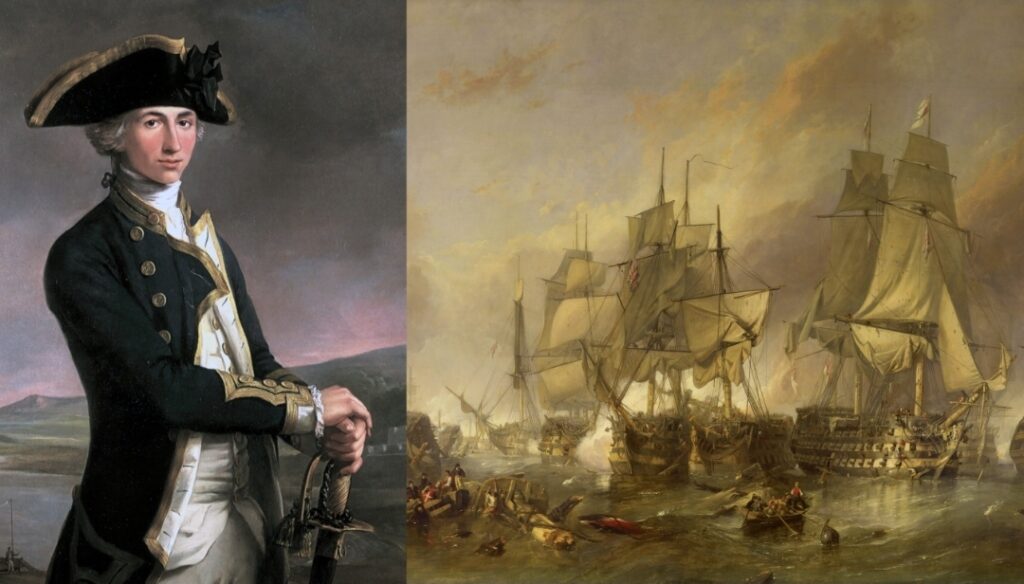
Nelson’s most famous battle took place off the coast of Spain at Trafalgar on October 21, 1805. At the time, France, led by Napoleon Bonaparte, hoped to invade Britain but needed to control the seas first. The French and Spanish fleets joined forces against Nelson’s British fleet.
Nelson had fewer ships and guns than his opponents, making the battle very risky. Before the fight, he sent his famous signal to inspire his sailors: “England expects that every man will do his duty.” Nelson’s plan was daring: he ordered his ships to break the enemy line into two parts, rather than attacking in a traditional, straight line. This bold move surprised the enemy and allowed the British to attack from both sides, causing confusion.
Nelson’s flagship, HMS Victory, led the charge and became locked in close battle with several enemy ships. Nelson was at the center of the action, showing great courage. During the battle, he was shot by a French marksman from the ship Redoutable, seriously wounded, and taken below deck. Even while dying, Nelson wanted news of the fight (Just like Lachit Borphukan did in Saraighat, he was sick, yet wanted to know every detail of the battle). When told the British had won, he replied, “Thank God I have done my duty.”
He died shortly after, never seeing the celebrations that followed. The victory at Trafalgar was complete: the enemy’s fleet was destroyed, ending the threat of a French invasion of Britain. Nelson’s actions and leadership had changed history, and his tactics became legendary in naval warfare.
If one reads the book edited by H.K Barpujari named “The Comprehensive History of Assam” Volume 2, it can be spotted by the reader that the author compares Lachit Borphukan at Saraighat with Horatio Nelson at Trafalgar. The comparison does make sense because Lachit Borphukan and Horatio Nelson were both famous military leaders known for defending their homelands with courage and excellent strategy.
Lachit Borphukan was a general in the Ahom Kingdom (now Assam, India). He is celebrated for leading his troops to victory against the much larger Mughal forces in the naval battle of Saraighat in 1671. Horatio Nelson was a British naval commander who became a national hero for his victories during the Napoleonic Wars, especially the Battle of Trafalgar.
Despite being ill, Lachit inspired his soldiers to fight, especially in naval warfare, to win against the enemy forces of the Moguls. While Nelson was known for his bravery and innovative strategies, even after losing an arm and an eye in battles, he continued to command and lead his fleet to several important victories, often fighting despite his injuries.
Both Lachit Borphukan and Horatio Nelson saw victory, but couldn’t take part in the celebrations due to their unfortunate demise and now both of them are recognized as National heroes, one of England and one of Assam. It would not be wrong to say that Horatio Nelson is indeed the Lachit Borphukan of England.