


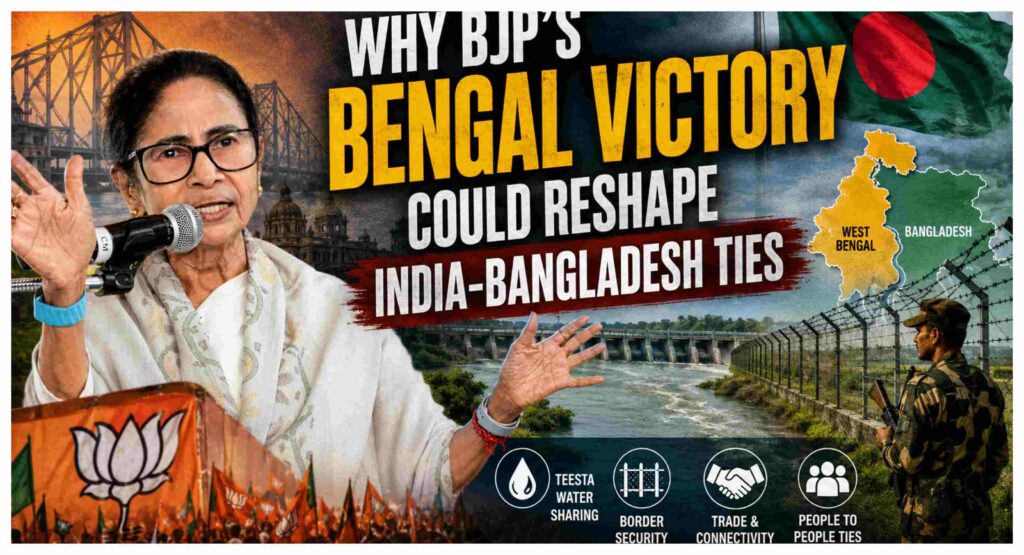
The Bharatiya Janata Party’s decisive victory in the 2026 West Bengal Assembly elections is being viewed as more than just a state-level political shift. By ending the Trinamool Congress’s 15-year rule, the result has reopened key questions around India-Bangladesh ties—especially on border management, migration concerns, and the long-stalled Teesta water-sharing deal.
West Bengal holds strategic importance in this equation. It shares a 2,216-kilometre boundary with Bangladesh—the longest such border for any Indian state. This stretch includes riverine terrain, densely populated zones, and corridors historically linked to smuggling and illegal crossings.
The political change has not gone unnoticed in Bangladesh. Leaders from the Bangladesh Nationalist Party (BNP) have welcomed the BJP’s victory, suggesting it could unlock better coordination between Dhaka and Kolkata—particularly on unresolved issues like the Teesta agreement.
Why Bengal Sits At The Heart Of The Equation
India-Bangladesh relations have long been defined by both cooperation and friction. While the two countries have made progress in trade, connectivity, and security collaboration, disputes over river waters, border fencing, migration, and cross-border violence continue to surface.
West Bengal is central to nearly all of these issues. Whether it is water-sharing negotiations, border infrastructure, or trade routes, the state’s role is unavoidable.
With the BJP now in power both at the Centre and in West Bengal, a key political hurdle may have been removed. Alignment between Delhi and Kolkata could enable smoother coordination on sensitive matters that previously faced resistance due to political differences.
Teesta Dispute Back In Spotlight
Among the most critical unresolved issues is the sharing of Teesta river waters. Bangladesh has consistently argued that reduced water flow during dry seasons has serious consequences for agriculture in its northern regions.
Despite multiple rounds of negotiations, a final agreement has remained elusive. While India and Bangladesh have signed treaties on the Ganga (1996) and Kushiyara rivers, the Teesta deal has not materialised.
A proposed agreement in 2011—during then Prime Minister Manmohan Singh’s visit to Dhaka—suggested a division where Bangladesh would receive 37.5% of the water and India 42.5%. However, the plan stalled due to objections from the West Bengal government, which cited concerns over its own irrigation needs.
An earlier interim arrangement in 1983 also failed to take off in practice.
Now, with a new government in Bengal, there is renewed optimism in sections of Bangladesh that negotiations could move forward.
BNP leader Azizul Baree Helal has openly linked the BJP’s victory to the possibility of progress, arguing that previous resistance from the state government had been a major obstacle.
The timing adds urgency. The 1996 Ganga Water Treaty is set to expire later this year, making broader water-sharing discussions even more critical.
Sharper Focus On Border Security
The BJP’s victory is also expected to influence India’s approach to border security along Bangladesh.
For years, the party has accused the previous state government of being lenient on illegal immigration—an allegation the Trinamool Congress has consistently denied. Nonetheless, the issue has remained politically significant in Bengal.
India has already fenced around 78–80% of its 4,096-kilometre border with Bangladesh, but gaps remain—particularly in difficult riverine stretches within West Bengal.
With the same party governing both the Centre and the state, there may be a stronger push to complete fencing, enhance surveillance, and improve coordination between state police and central forces like the Border Security Force.
Concerns have also been raised about the growing influence of Islamist groups such as Jamaat-e-Islami in certain Bangladeshi regions bordering West Bengal. Their recent electoral gains in areas like Khulna, Rajshahi, and Rangpur have added a new layer of security sensitivity, with fears of potential spillover effects.
Trade, Connectivity May Get A Boost
Beyond security, the political shift could also accelerate economic cooperation.
Kolkata serves as a key gateway for India-Bangladesh trade. With political alignment between Delhi and Kolkata, projects involving border haats, transport links, ports, and energy cooperation could move faster.
Cultural and linguistic ties between West Bengal and Bangladesh remain strong. A new government in the state may seek to deepen these connections while maintaining a firmer stance on security and migration.
A Diplomatic Link In Dinesh Trivedi
Another significant development is the appointment of Dinesh Trivedi as India’s High Commissioner to Bangladesh.
A former Trinamool Congress leader who later joined the BJP, Trivedi brings with him deep experience in Bengal politics and an understanding of regional dynamics. His presence in Dhaka could help bridge political and cultural gaps in negotiations involving issues where West Bengal plays a direct role.
What Lies Ahead
While the BJP’s win in Bengal could streamline coordination between Delhi and Kolkata, the future of India-Bangladesh relations will depend equally on Dhaka’s responses.
Key questions remain—whether the Teesta deal can finally be resolved, how border concerns will be managed, and how both sides address sensitive issues such as migration and minority rights.
The political shift in Bengal has created an opening. Whether it leads to a breakthrough or renewed tensions will depend on how both countries navigate this moment.