


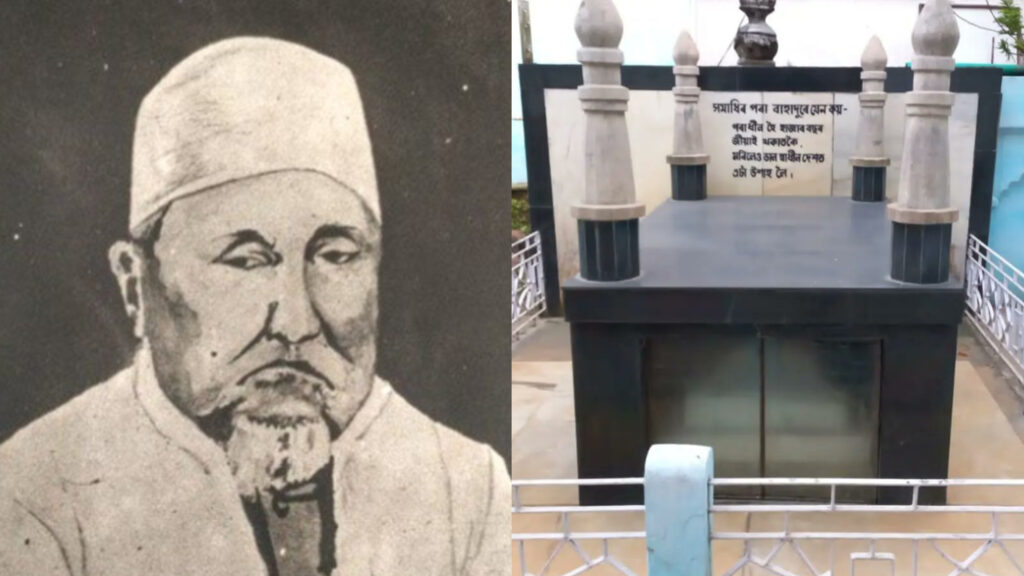
Life of Bahadur Gaonburah
By Muhammad Talha Amin Baruah
Bahadur Gaonburah was born in the year 1819 in Ahom kingdom. He was a legendary freedom fighter of India and a key figure in the 1857 revolt against British rule at Assam. His real name was Sheikh Bahadil. He hailed from a respected family that held the royal position of ‘Akhorkota Barua’, responsible for recording land grants for the Ahom kings. The Akhorkotas were imported by the Ahom kings during their reign from West of then Hindustan because these Akhorkotas were very precise with their carvings. Among their descendants is Bahadur Gaonburah who was appointed as the village headman of Jorhat and Titabor by the British East India company. He earned the title “Bahadur” for his remarkable courage and leadership skills. He was a remarkable craftsman of ivory products as well (some of his works of Ivory are even preserved today at Auniati Satta at Majuli).
During the First War of Independence in 1857, Mohammad Bahadur Gaonburah became a close aide to Maniram Dewan and Piyali Baruah, two prominent Assamese revolutionaries. Bahadur was an expert in repairing old arms and weapons, it might be the reason why Maniram included him in his plot against the englishmen. Bahadur is said to have been a practicing muslim and that he was a pious man, hence he was trustworthy according to Maniram Dewan. Bahadur is depicted to have had a little beard on his chin, but with no moustache. He used to wear simple clothes like a Kurta and a lungi. His main role was to mobilize support among the Muslim community and arrange arms for the uprising. His role of mobilizing the support of Muslims for the rebellion was tasked by Maniram Dewan himself. Bahadur’s efforts brought together people from different backgrounds, strengthening the movement against the British in Assam.
The rebels held multiple meetings, they planned to wage a war against the Britishers and revive the Ahom kingdom. They choose Kandarpeshwar Singha as the true heir to the throne and that when Maniram would return to Assam, Kandarpeshwar would be coronated as the Ahom king as per Tai-Ahom customs. But their plan didn’t become reality and the British East India company cracked down on the rebels. They were swiftly defeated because of which all the rebels, including Bahadur was arrested and put on trial for treason in Jorhat jail, alongside Formud Ali and others. While Dewan and Baruah were hanged, Bahadur was sentenced to life imprisonment in the notorious Cellular Jail of Kala Pani in the Andaman and Nicobar Islands. When the British East India Company was dissoluted and the British rule was directly established by Queen Victoria on India, all the rebels who didn’t kill any Britisher were granted amnesty. He had spent 14 years in harsh conditions at Kalapani, before his sentence was commuted, allowing him to return to Assam.
Bahadur Gaonburah’s legacy lives on in Assam, especially in Jorhat, where he served as a respected leader. He died in 1891 at his son’s residence at Titabor. He was buried at New Balibat in Jorhat. Today, Bahadur Gaonburah is remembered as a symbol of communal harmony and resistance. His tomb lies within the New Balibat mosque compound in Jorhat, and his story is celebrated by people of all communities. His courage, leadership, and sacrifice continue to inspire generations in Assam. Bahadur Gaonbura was so dedicated to the freedom struggle that he could not think about anything except his country’s freedom, his country’s welfare and his king.
Note: There are thus some books which claim that Formud Ali was Bahadur Gaonburah or Zulfikar Barua was Bahadur Gaonburah. But it should be noted that the three of them are three different people. The depiction of Bahadur Gaonburah is also labeled as ‘Formud Ali’ even by some reputed sources.
Bibliography:
- Axomor Musolmaanhokol, by Abdur Rahman, page 181
- Nationalist upsurge in Assam, by Debo Prasad Barooah, page 54
- Encyclopedia of North-East India, by Col Ved Prakash, volume 1 page 274
- Assam’s struggles against British rule (1826–1863), by Hemeswar Dihingya, pages 118–120
- The Brahmaputra Beckons, page 212
- 1857 in Assam, by Mahendra Bara, page 30
- Cultural identity of indigenous Assamese Muslims, by Wasbir Hussain, page 17
- Swargadeo Rajeshwar Singha, by Dr. Surrya Kumar Bhuyan, pages 198–199