


By Muhammad Talha Amin Baruah
Mahapurush Madhabdev was a revered saint, poet, and spiritual leader whose teachings and works have shaped the soul of Assamese society for centuries. His journey from a passionate scholar of Saktism to the ‘Prana Bandhava’ (soul friend) of Srimanta Sankardev and the torchbearer of Assamese Vaishnavism (or Eksarana Dharma) is a story of deep transformation, compassion, and cultural renaissance.
Madhabdev was born estimately in May or June of 1489 in Letekupukhuri (present-day Lakhimpur district) to Govindagiri Bhuyan and Manorama Devi. Growing up, he was surrounded by tales of family migration and hardship, as his father moved from Bardowa (now in Bangladesh) to Assam due to political unrest. Despite these early challenges, Madhabdev’s childhood was rich with learning. He received his primary Education at Narayanpur and later continued his studies in Banduka, acquiring deep knowledge of the Tantras and the Puranas under the influence of Saktism.
As a young adult, Madhabdev was a staunch follower of Saktism. However, the turning point in his life came at age of 32, prompted by his personal crisis. This transformation took place during a spiritual debate with Srimanta Sankardev, orchestrated by his brother-in-law Ramadasa, who had left Saktism to embrace the Xonkoriya beliefs. When the debate ended, Sankardev recited a verse from the Bhagavata Purana which moved Madhabdev deeply and led him to accept Sankardev as his Guru. He broke his engagement, renounced worldly pleasures, and dedicated his life to the Vaishnavite movement.
After his conversion to Eksarana Dharma in 1522, Madhabdev became the closest companion of Sankardev and was regarded as his “Prana Bandhava”. Sankardev recognized Madhabdev’s brilliance and later announced him as his spiritual successor. Together, they spreaded the Eksarana Dharma, which emphasized direct relationship with Lord Krishna, simultaneously encouraging equality, communal worship, and respect for all.
Madhabdev played a central role in establishing Satras and Namghars across Assam. These spaces were designed to be open and inclusive, promoting unity and shared devotion among people from all backgrounds. The iconic Dhekiakhowa Bornamghar in Jorhat, founded by Madhabdev in 1528, stands as a living symbol of this legacy.
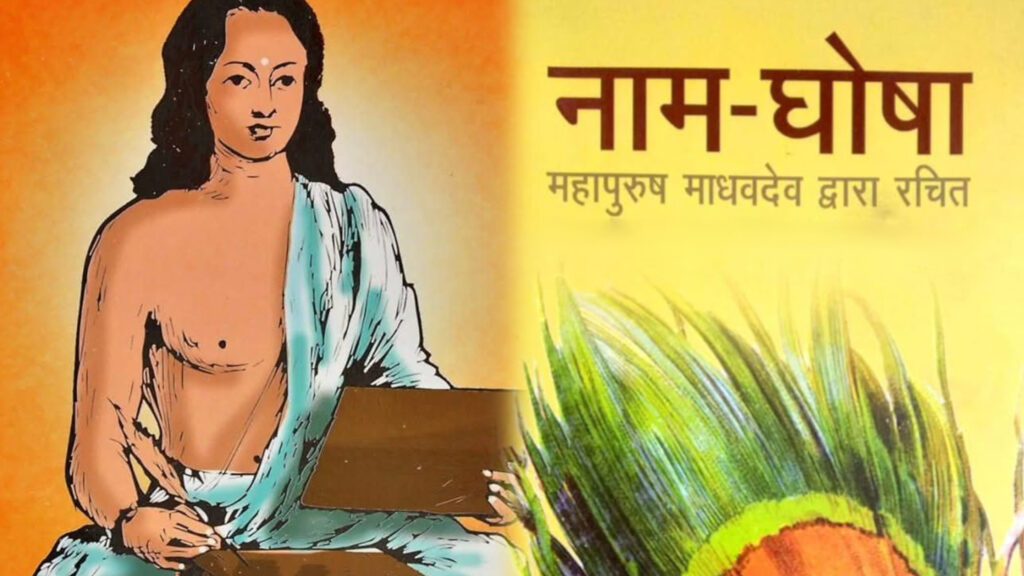
Madhabdev’s literary works marked a golden era in Assamese culture. His works became the bedrock of Assamese Vaishnavism (or Xonkoriya-ism) and a source of comfort to generations of devotees. Notable contributions of him include Namghosa, Bhakti Ratnavali, Borgeet and Jhumuras. His writings are recognized for their poetic nature and clarity of thought, and universal appeal, making them easily accessible to anybody.
After Sankardev’s death in 1568, Madhabdev became the spiritual leader of the Xonkoriyas. He travelled widely, spreading the faith and establishing more Satras, bringing people together under a message of compassion, equality, and brotherhood. His organizing skills, kindness, and unwavering commitment helped stabilize and popularize the Bhakti movement In Assam. Even in times of hardship—political unrest, migration, or opposition—Madhabdev remained steadfast and compassionate.
Madhabdev’s final years were spent in dedicated literary and religious pursuits, maintaining close contact with his followers and continuing to guide the growing movement. He sadly passed away in 1596 at Bhela Satra in Koch Bihar, leaving behind a legacy of spiritual literature, song, and community institutions that continue to inspire and unite people to this day.
Today, Madhabdev’s legacy is alive not just among the Xonkoriyas, but among all the Assamese people despite of religion. His writings remain relevant, offering inspiration and practical guidance for his followers. The story of Madhabdev reminds everyone that life’s true richness lies in learning, loving, and living with integrity. His timeless legacy invites future generations to uphold these values—for the benefit of all.