


By Muhammad Talha Amin Baruah
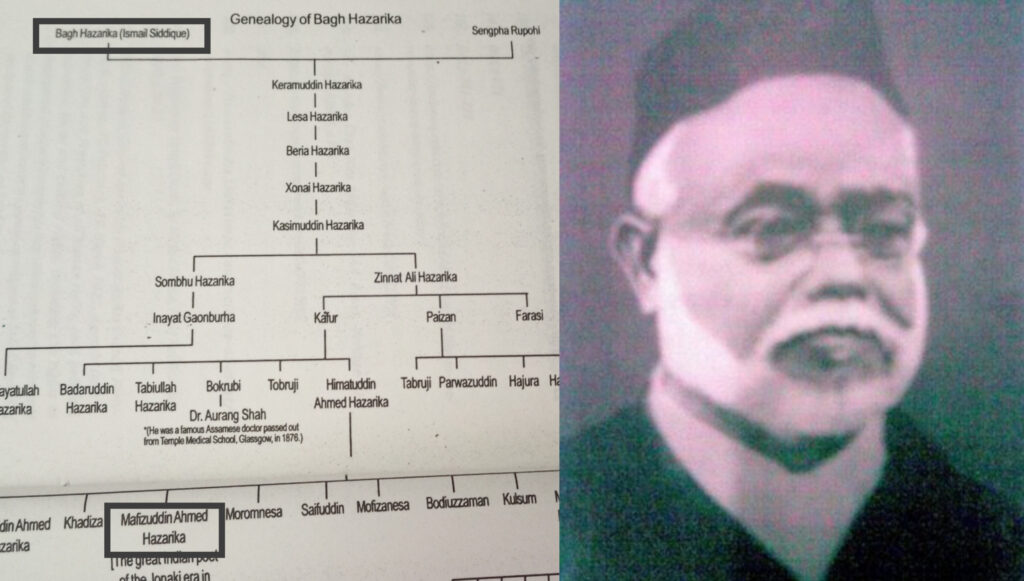
Mafizuddin Ahmed Hazarika (1870-1958) was a distinguished Assamese poet of the Jonaki era, famously known as “Gyan Malinir Kobi”. He was a spiritualist and a philosophical poet in Assamese literature. Hazarika served as president of the Asam Sahitya Sabha in 1930 and contributed richly to Assamese poetry. Mofizuddin Ahmed Hazarika was born on August 30, 1870, in Dibrugarh, Assam, to Himmatuddin Hazarika. As the ninth-generation descendant of the esteemed Bagh Hazarika, a figure of pride in Assamese history, he carried forward a notable family legacy.
After failing his entrance examination at Dibrugarh Government High School in 1892, Hazarika pursued a career in forestry in North Lakhimpur following his schooling. He served there for three years before being appointed as a court officer in Lakhimpur. In 1902, he transferred to the Dibrugarh Kachari, where he rose to the position of peskar and retired in 1926. He was a dedicated literary figure. Hazarika was involved with the Assam Sahitya Sabha from its inception. He was elected as an executive member during the session at Rangpur Nagar, Sivasagar, on December 26–27, and served as secretary of the dibrugarh Sahitya Sabha for 50 years, from 1904 onward. He also presided over the Chhatra Sabha in Sivasagar.
Renowned as a poet, Hazarika published his first collection, ‘Gyan Malini’, in 1896, earning him the enduring title of the “Poet of Gyanmali.” His second work, ‘Tattva Parijat’, yielded only four recovered poems, yet his contributions to Assamese literature remain celebrated. Even literary legends such as Dr. S.K Bhuyan notes Hazarika’s name as ‘Gyan Malinir Kobi Mafizuddin Ahmed Hazarika’ in his works where he mentions about Bagh Hazarika’s life. Bhuyan credits Mafizuddin each time for sharing the history of Bagh Hazarika.
In the expansive realm of Assamese literature, Mofizuddin Ahmed Hazarika authored a single, enduring collection of poetry that secured his legacy for generations. His exceptional talent earned him a literary pension from the government, recognizing his profound contributions.
Hazarika’s work masterfully captured the ambiguities and incompleteness in people’s understanding of key words and phrases in everyday language and discourse. Through the verses of ‘Gyan Malini’, he expressed a philosophical aspect, reminding readers that even the cemetery – a universal endpoint, awaits everyone after life’s long journey. No matter one’s pride or wealth, the illusions of the world dissolve when the light of life fades. This philosophy, woven throughout his poems, reflects his view of existence as a transient path to be navigated with honesty and reflection. Born into the illustrious Hazarika family, Hazarika endured personal hardships, yet they never dimmed his spirit. Instead, he inspired others to lead virtuous lives, measuring earthly existence by integrity and purpose. His invaluable counsel, delivered through poetry and literature, continues to guide and uplift.
Hazarika also served as President of the Assam Sahitya Sabha during its session in Golaghat in the year 1930. Further cementing his role in the cultural landscape. The esteemed poet passed away on October 29, 1958.
References :
Asomor Musalmansakal (2013) by Abdur Rahman, Chandra Prakash. Pg. 165-166
Itihasar Sa Poharot Goria-Moria-Deshi (2024) by Mukut Sarma, Hangdan Prakashan. Pg. 323