



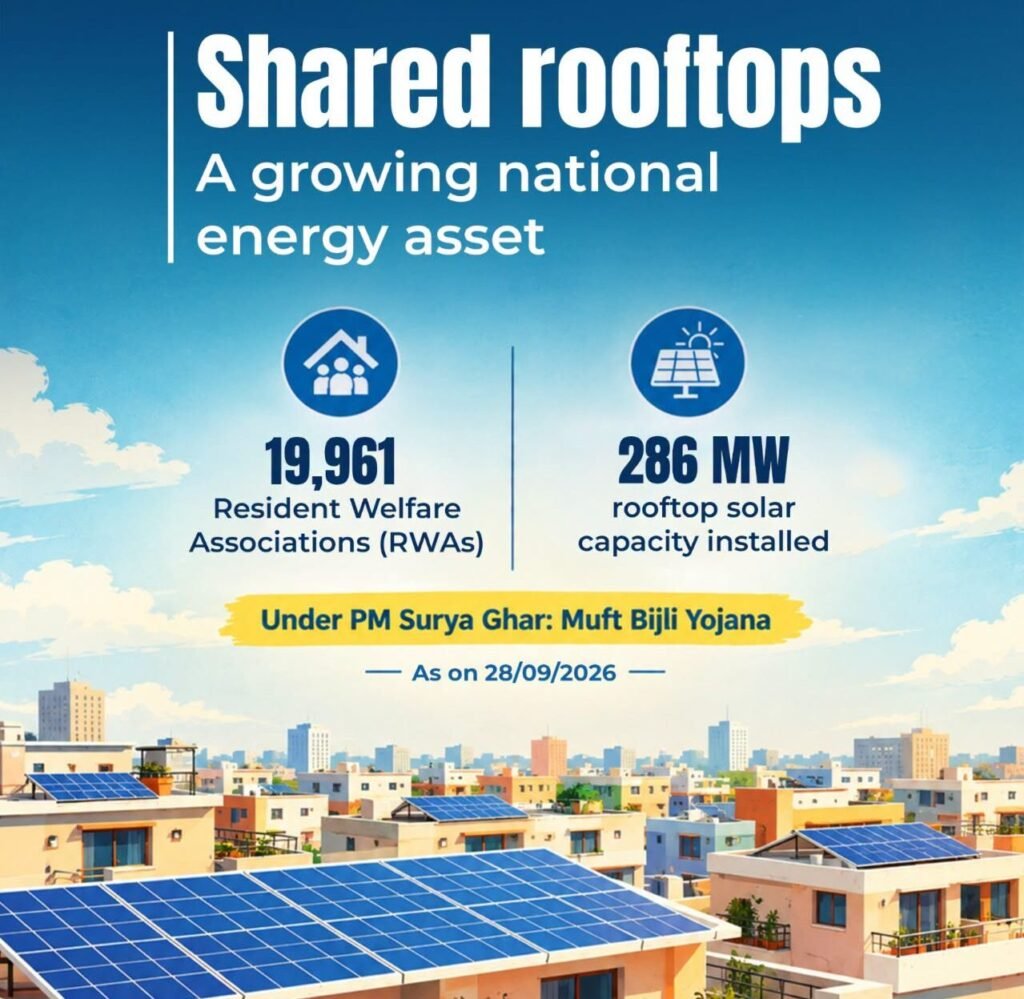
“The PM Surya Ghar: Muft Bijli Yojana has truly transformed into a mass movement, ultimately ensuring welfare and savings for the people, the states, and the entire country”, said Union Minister for New and Renewable Energy, Education and Consumer Affairs, Food and Public Distribution, Pralhad Joshi at a fireside chat during the 3rd day of a Bharat Renewable Energy Summit & Expo 2026.
Union Minister Shri Joshi highlighted that India is now completing approximately one lakh rooftop solar installations every six days because of the rooftop solar initiative. He noted that this is not only reducing emissions but also strengthening India’s energy security during peak hours. Emphasising the tangible benefits, he stated that millions of households are achieving zero electricity bills and generating substantial collective income by selling surplus power back to the grid. He further highlighted India’s exponential growth in solar energy, with installed capacity increasing from a mere 3 GW in 2014 to 172 GW today.

The Next Terawatt Diplomatic Dialogue, addressed by Minister of State for New and Renewable Energy, Shripad Yesso Naik, underscored that the next terawatt of clean energy will require collective collaboration across countries, technologies and institutions. The minister also sought the views of the diplomats on country partnerships, investment, technology, implementation and capacity building.
India’s solar manufacturing sector has expanded significantly, with module manufacturing capacity crossing 200 GW and solar cell manufacturing reaching approximately 45 GW. The country is also advancing wind energy manufacturing, with domestic capabilities now covering a significant share of the turbine value chain. BRE Summit and Expo 2026 is providing a platform for manufacturers, technology companies, investors and policymakers to explore pathways for deeper domestic and international collaboration across the clean energy manufacturing ecosystem.
As renewable energy capacity expands, energy storage and transmission infrastructure are becoming central to grid stability and the reliable integration of variable renewable power.