


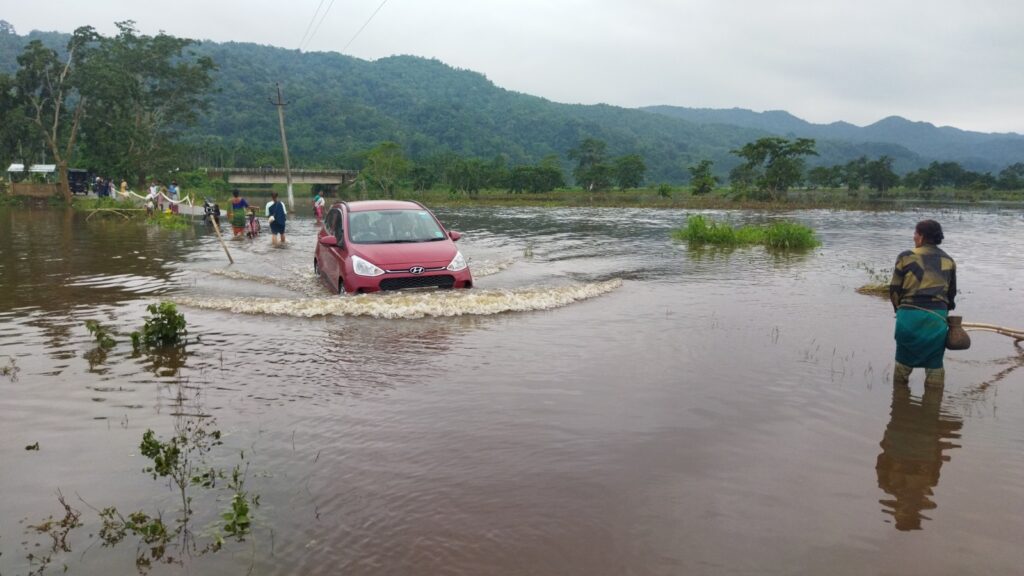
PALASBARI, June 2– While visuals from Guwahati have already stirred public concern, the ongoing spell of relentless rainfall across Assam is wreaking quiet devastation in rural belts, particularly within the Rabha Hasong Autonomous Council (RHAC) area of South Kamrup. The rising waters of Chandubi Lake, fed by runoff from the Meghalaya hills, have spilled into the adjoining Chakni Lake, triggering widespread inundation.
The region’s Batha and Kalahi rivers, now flowing with dangerous velocity, have further compounded the situation. As a consequence, the road connecting Chandubi to Rajapara and Ranikhamar lies submerged across several critical stretches, notably at Shingimari and Kathalguri.
According to residents, vehicular movement along the route came to a complete standstill on May 31 due to severe waterlogging. In a makeshift response, locals resorted to using boats for mobility—a rare but telling image of rural resilience. Elderly villagers recalled how, two decades ago, travel during the monsoons meant relying on boats when the unpaved road would dissolve into mud.
“After the road was elevated and blacktopped, we believed those hardships were behind us. But now, it feels like we’ve gone back 25 years,” said one local.
Fortunately, a brief break in rainfall today has led to a marginal drop in water levels, allowing some vehicles to pass with caution. In an unusual sight, villagers were also seen casting nets and laying traps on the flooded road, making use of the circumstances for fishing.
Meanwhile, the Kalahi river and its key tributary, the Kulchi-Kukurmara stream, remain swollen. Of particular ecological concern is the fact that the latter serves as a critical breeding habitat for the endangered South Asian river dolphin. However, this surge is unlikely to last. In a matter of days, the stream is expected to shrink back into its degraded, marsh-like state—reflecting a troubling shift from perennial river to seasonal trickle.
The episode has renewed questions around infrastructure planning, river management, and the broader environmental sustainability of the region, exposing the fragile intersection of human development and nature.