


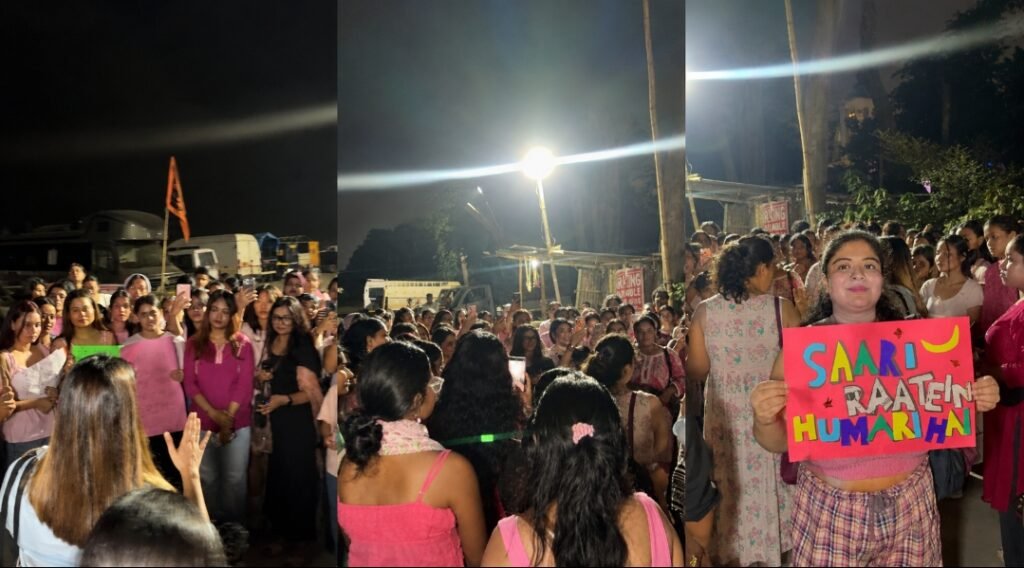
GUWAHATI, October 3: Hundreds of women dressed in pink walked through the streets of Guwahati on Saturday evening, moving from Dighalipukhuri to Lachit Ghat in a collective statement about women’s safety, freedom and their right to occupy public spaces at any hour.
The walk, which began around 7 pm, was part of a larger wave of women-led actions taking place across India. From Delhi and Bengaluru to Mumbai, Kolkata, Panjim, Bhubaneswar and Guwahati, women have been coming out onto the streets to question a familiar idea: that women must change their movements, clothes, routines and lives because public spaces, particularly at night, are considered unsafe for them.
In Guwahati, the message was visible in pink.
Women walked together through the city, many dressed in pink, as conversations about women’s safety have once again come sharply into focus. The walk was not simply about one incident or one night. It was about something much larger — the right of women to move through their own city without fear.
One protester explained why the streets at night matter:
“The whole idea is to reclaim the streets at night because whenever cases of sexual violence or assault come out, it is always, ‘What was she wearing? What was she doing at night? Where was she going at night?’ We want to break this idea that streets are unsafe for women at night. When we come out onto the streets, we are visible. As equal citizens, the streets belong to us equally. We are here to show our visibility. We are here to reclaim the fact that the streets also belong to us,” said a protester.
The words reflect a question that women across the country have been asking for years: why should the responsibility for safety always begin with restricting women?
Why should a woman have to explain where she was, what she was wearing, who she was with or why she was outside after dark?
The walk challenged that thinking by doing something simple — women came out and walked together.
For some participants, the experience was both empowering and painful. Uddipana, who said she was not an organiser but joined after seeing the gathering, spoke about the significance of women coming together.
“I’m not an organiser. I just came to see what was happening and realised that so many women had come together. I thought, ‘Let’s go and see what is happening,’ and started walking with them. I started recording it, and it is amazing to see how people are coming together and women are standing up for themselves and for each other. At the same time, it is sad that for our basic rights and dignity, we have to do something like this. But at the same time, we have started claiming our space, and that is wonderful to see. It is much needed because how long are we going to live like this? How long will we remain locked inside our homes, sharing live locations, living in fear, receiving ten calls asking whether we have reached home? Why? Because we feel unsafe. Even while we were walking, people were trying to bully us. One vehicle came and almost hit us. What madness is this? This is not a battle or war against men. It is simply a woman versus patriarchy. And if you do not believe in patriarchy, you are on our side. That’s all. I am happy and equally sad that we are claiming our space, but it is what it is,” said Uddipana.
Her experience also points to the contradiction at the heart of the movement. Women were walking together to demand a safer public space, yet even during that walk, they encountered behaviour that made them feel unsafe.
That contradiction is perhaps why such walks continue to matter.
Across India, women have been organising and participating in walks and protests that question the idea that the night belongs more to men than women. In Bengaluru, women marched through the city on October 2, carrying flashlights and torches. Similar actions were also reported in several other cities, including Delhi, Mumbai, Guwahati, Panjim, Kolkata and Bhubaneswar.
In Delhi, women also took part in a midnight walk in Vasant Kunj, continuing a longer tradition of women walking together at night to challenge the restrictions placed on their movement after dark.
Guwahati, too, has now spoken.
The city’s women walked together, dressed in pink, occupying the roads not as visitors but as citizens.
For Anurekha, the question is even bigger than being able to walk home safely at night. It is about reclaiming an entire part of life that women often feel they have lost.
“The whole night belongs to us. Nighttime is something that has been taken away from us. It has been snatched away. My mother calls me asking when I am coming home. Even when I am at a protest, my parents call because they are concerned, and of course they will be concerned because nighttime has been taken away from us. Every moment has been taken away from us. So we want to reclaim the streets. We want to reclaim everything because I think enough is enough. I think we are not angry enough. All nights are ours, all evenings are ours, all afternoons are ours, all mornings are ours. Everything that has been taken away from us belongs to us,” said protester Anurekha.
More Than a Walk
The women walking through Guwahati on Saturday were not asking for special treatment.
They were asking for something much more basic — the freedom to exist in public spaces without fear.
For many women, safety has become a daily calculation. It can mean sharing a live location with family, calling someone while travelling, avoiding certain roads, returning home before a certain hour or repeatedly answering the question, “Have you reached?”
These precautions have become so normal that they are often treated as part of everyday life.
But the women who walked through Guwahati were questioning that normal.
They were asking why women should have to adjust their lives around fear instead of society working to make public spaces safer.
The timing of the Guwahati walk also comes amid renewed public attention to women’s safety following an alleged assault of a woman at a nightclub in the Khanapara area on October 2. Police arrested seven people in connection with the case on October 3, according to reports, and the investigation is continuing.
The nightclub incident and the women’s walk are separate developments, and there is no basis to say that the walk was organised solely in response to that case. But both have brought the question of women’s safety in Guwahati into public discussion at the same time.
The larger issue remains.
A city cannot be truly accessible to everyone if half its population has to think twice before stepping out after dark.
Safety cannot mean telling women where they should or should not go. It also has to mean creating public spaces where women can walk, work, travel, socialise and return home without fear.
Assam Has Spoken
For years, conversations about women’s safety have often remained confined to homes, social media discussions, news reports and private conversations between friends.
On Saturday night, that conversation came onto the streets of Guwahati.
From Dighalipukhuri to Lachit Ghat, hundreds of women walked together.
They wore pink.
They walked together.
They spoke about fear, freedom, dignity and the right to the city.
And, in doing so, Assam added its own voice to a wider national conversation.
The message was simple.
The streets are not meant to belong to men alone.
The night is not a time that women should have to surrender.
And walking home should not have to be an act of courage.
For the women who stepped out in Guwahati on Saturday, the walk was a way of saying that the city is theirs too.
All nights are ours. All evenings are ours. All afternoons are ours. All mornings are ours.