


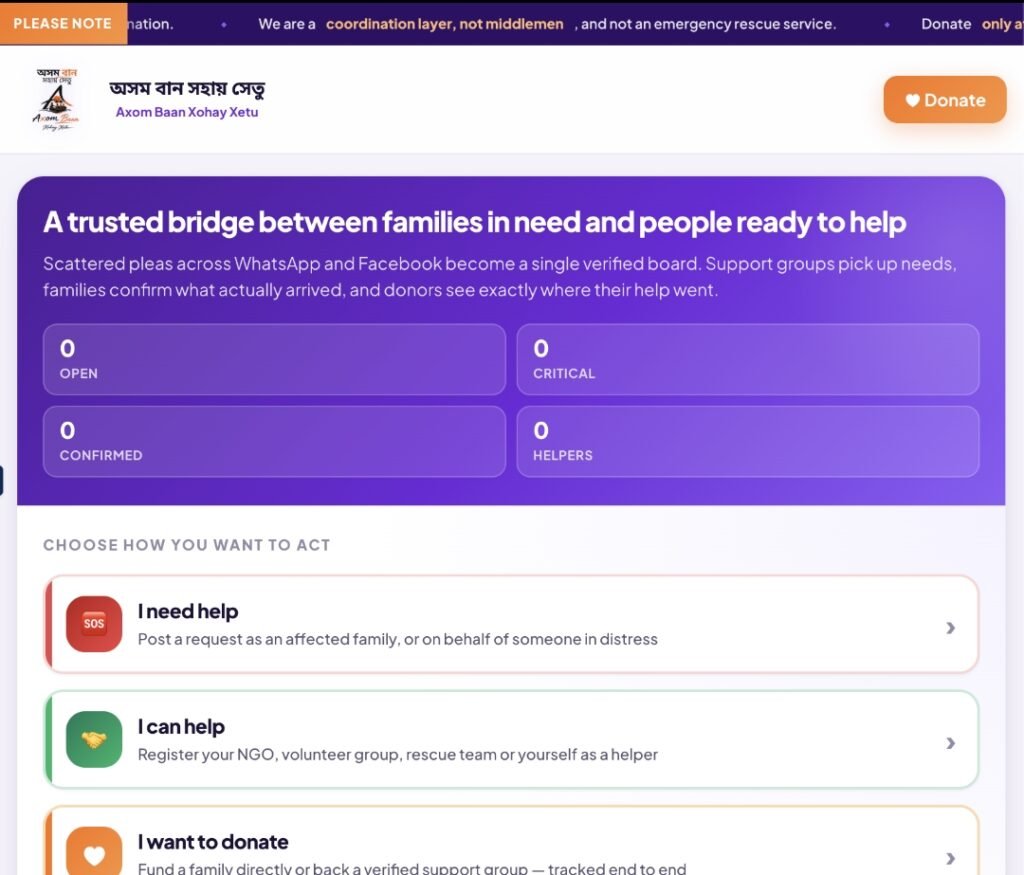
Axom Baan Xohay Xetu intends to turn scattered social media pleas into a single verified place of who needs help, who is helping, and what actually arrived
Guwahati, Assam | 05-08-2026
As floodwaters continue to displace families across Charaideo, Sivasagar, Jorhat, Golaghat and neighbouring districts of Assam, a young Assamese entrepreneur has launched অসম বান-সহায় সেতু (Axom Baan-Xohay Xetu), a free, community-driven digital platform designed to connect flood-affected families with volunteers, relief organisations, and individual donors through a single, transparent interface.
Accessible at www.axombaanxohayxetu.in, the platform is intended to act as a meaningful coordination layer, bringing together scattered requests for help, relief efforts, and community support in one place. The platform does not attempt to rescue anyone, raise funds, or replace any official machinery. It attempts something narrower.
Every monsoon, Assam demonstrates extraordinary civic responsibility. Within hours of the first breach, social media channels fill with locations, phone numbers, requests and appeals for help. Timelines carry details of stranded families and individuals and support groups mobilise.
And, almost all of it disappears within a day.
A genuine plea posted at 11 p.m. is buried under feeds by morning. Three different volunteer groups drive to the same village while an adjacent one waits. A donor in Bengaluru wants to transfer funds to the needy but has no way to reach directly. And once the water recedes and the news cycle moves on, there is no record at all of what was needed, what reached, and what never did.
What Axom Baan Xohay Xetu does
The platform creates a single, public, verified board with four moving parts:
1. A family raises a request. An affected household, or an informer reporting on their behalf posts what is needed, where, and how urgent it is, with a pinned location and photographs, if available. Exact coordinates are released only to the group that takes up the request; the public board shows an approximate area.
2. A registered support group picks it up. NGOs, youth organisations, rescue teams and individual volunteers register, get verified by a coordinator, and commit to requests they can actually attend to. On pick-up, they receive the family’s direct contact and precise location.
3. Support is delivered. Rescue, rations, shelter, cash, cleaning, rebuilding — whatever was asked for.
4. Only the family can close the request. This is the working logic the creator considers most important. A relief effort is not recorded as complete because a volunteer says so. It is recorded as complete because the affected family or thr informer confirms it arrived. That single constraint is what converts a wishlist into an audit trail.
Around this core, sit a live activity feed of ground updates, public profile pages and track records for every support group, a transparency dashboard of what was needed versus what actually reached families, a grievance channel, and a coordinator console where every moderation action is written to an audit log.
On the money front, the platform is hands-off. Funds move directly between donor and recipient over UPI or Bank details. The platform never holds, routes, or takes a cut of a single rupee. Payment details are hidden from the public board entirely and are revealed only after a coordinator has manually verified the family or group against an identity document.
The platform also points donors to the official Chief Minister’s Relief Fund website for contributions.
The site also carries live ASDMA bulletin figures and an embedded Google Flood Hub gauge and seven-day forecast for the Brahmaputra basin, so groups can anticipate where the next wave of requests will come from rather than only reacting to the last one.
A standard infrastructure
The idea is not novel. In much of the developed world, a coordination layer between citizens, responders and donors is treated as basic disaster infrastructure rather than a nice-to-have.
It is the simple premise that during a disaster, fragmented information is itself a form of harm and that reducing it is a public good worth building deliberately.
Assam has an experienced disaster authority, a capable SDRF and NDRF presence, and an unusually dense civil-society network. What it has not had is a shared, persistent, public layer where all three plus ordinary citizens can see the same picture at the same time.
A prototype, said plainly
The creators are explicit that this is an early-stage prototype.
Verifications layers are currently manual. Features are use-case driven and parts of the interface will change substantially as real usage exposes what does not work. The team would rather say this openly than let users form an expectation the platform cannot yet meet.
Feedback, criticism, bug reports and suggestions are actively invited through the grievance and feedback channel on the site. The team has committed to reading and responding to every one.
The people behind it
The initiative was conceived by Pritam Ranjan Deka, a young Assamese entrepreneur and a former Zoho employee, after watching the impact of the devastating floods. He built the platform, using AI-assisted development tools to go from idea to live platform in a short timespan.
“The willingness to help has never been the constraint in Assam. Coordination has. The generosity is already there, it is the plumbing that is missing. I felt technology could take one specific bite out of that problem: make the requests visible, make the helpers accountable, and let the flood affected family — not us, not the donor, not the volunteer — be the one who says whether help actually arrived.”
“I want to be very clear that this is version one and it shows. It is rough in places. We would much rather put a working prototype in front of Assam and be told what is wrong with it than spend weeks polishing something in private while the water is still in people’s homes.”
On the road ahead, Pritam is direct about wanting help:
“This is built in Assam, for Assam, and it should not stay in the hands of one individual. There is serious talent in our state, I would genuinely like to work closely with interested individuals or groups. If you can code, design, moderate, or simply tell us how relief actually works in your district, please reach out. I will make time for every single person who does.”
As Assam continues to face the brunt of devastating floods, the platform invites NGOs, youth organisations, rescue teams, volunteer groups, donors and citizens across Assam and the wider Assamese community to register, use the platform, and help improve it.
The creators reiterate that Axom Baan Xohay Xetu is a citizen-led supplementary initiative with no official affiliation or endorsement, it is intended to complement the work of the Government of Assam, district administrations, ASDMA, SDRF, NDRF, and the countless organisations and volunteers already working on the ground.
Register or explore the platform: http://www.axombaanxohayxetu.in