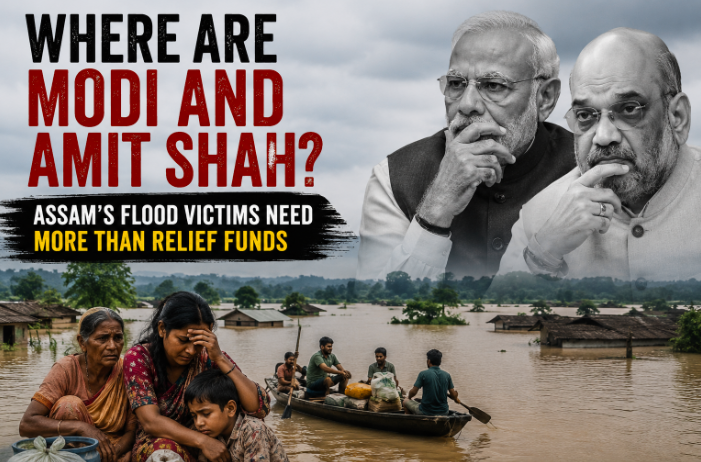
Where Are Modi and Amit Shah? Assam’s Flood Victims Need More Than Relief Funds
Opinion | Guwahati Times
Every year, the floodwaters return to Assam. Rivers swell beyond their banks, homes disappear under muddy water, families are forced into relief camps, and thousands struggle to rebuild lives that nature washes away in just a few days. This year has been no different. Entire communities have been displaced, livelihoods have been destroyed, and many have lost their loved ones.
The government machinery has been at work. Rescue teams have been deployed, relief camps established, and financial assistance announced. These efforts are necessary and deserve recognition. But for many people in Assam, there remains a question that goes beyond money and logistics.
Where are Prime Minister Narendra Modi and Union Home Minister Amit Shah?
The question is increasingly being raised across social media, public discussions, and among flood-affected communities. It is not merely about announcing financial packages or conducting review meetings from New Delhi. It is about presence. It is about standing with people in their darkest moments.
When disasters strike in different parts of the country, visits by national leaders often carry immense symbolic value. Such visits reassure citizens that the nation’s highest leadership stands with them. They draw national attention to the crisis, accelerate relief efforts, and send a powerful message that no state is alone in its suffering.
For Assam, however, many feel that such gestures have been missing during one of its most difficult times.
Floods in Assam are not isolated incidents anymore—they are recurring humanitarian crises. Entire districts battle devastating floods almost every monsoon. Families who have barely recovered from previous floods are forced to start over once again. Beyond damaged roads and bridges lie stories of children unable to attend school, farmers losing their crops, small businesses collapsing, and elderly people struggling without access to healthcare.
Financial assistance is undoubtedly important. Relief materials are essential. But human compassion cannot be replaced by compensation alone.
A visit by the Prime Minister or the Home Minister would not magically solve Assam’s flood problem. It would not stop the rivers from overflowing. But it would demonstrate solidarity with millions of people enduring hardship. Sometimes, leadership is measured not only by policy decisions but also by being physically present when citizens need reassurance the most.
Critics argue that Assam often receives attention only during elections or major political events, while recurring natural disasters fail to attract the same level of national focus. Whether that perception is fair or not, it exists among many residents and deserves acknowledgment.
Assam has always contributed immensely to India’s cultural, strategic, and economic landscape. During times of crisis, its people expect not only administrative support but also emotional and moral support from the country’s top leadership.
Ultimately, disaster response is about more than helicopters, relief camps, and compensation packages. It is about empathy. It is about letting affected families know that their suffering is seen, their voices are heard, and their struggles matter to the nation.
The people of Assam do not merely seek financial aid. They seek reassurance. They seek solidarity. Above all, they seek the comforting presence of leaders who represent the entire country.
As the floodwaters slowly recede, one question continues to echo across the state:
Will the nation’s highest leaders stand beside Assam not only through announcements, but also through their presence?
Disclaimer: The views and opinions expressed in this article are solely those of the author, Dharani Kalita, and do not necessarily reflect the views, editorial position, or policies of Guwahati Times, its editors, management, or staff. This article is published as an opinion piece in the interest of promoting public discourse and debate.