Dimbeswar Neog – the human rainbow of Assamese poetry
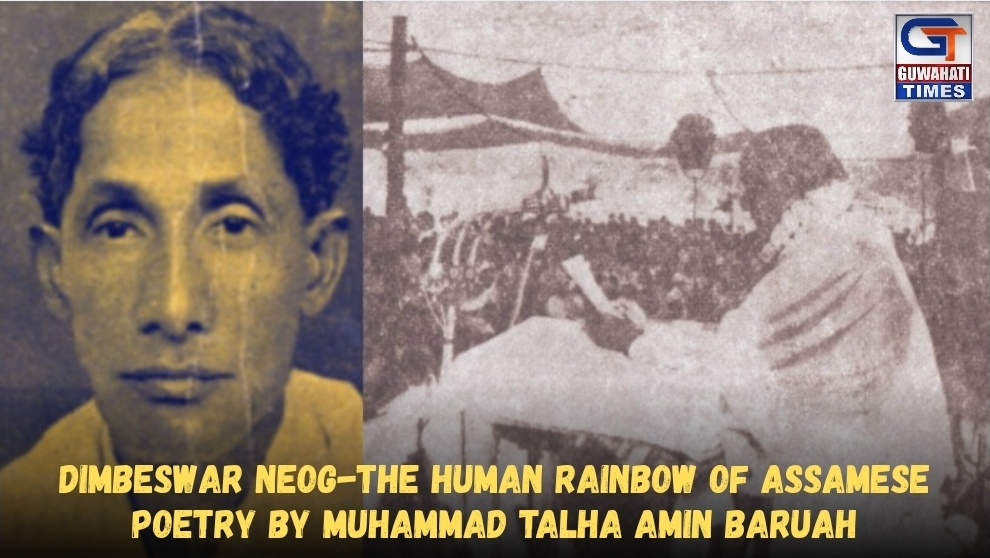
by Muhammad Talha Amin Baruah
Dimbeswar Neog (1899-1966) was a distinguished Assamese poet, writer, critic, and educator born on 7 August 1899 in the village of Kamarfadia, Sibsagar district, Assam. He was affectionately known as the “Indradhenu Kobi” (Rainbow Poet), a title reflecting his colorful and multifaceted contributions to Assamese literature. He was the eldest child of Manik Chandra Neog and Chandra Prabha Neog. His early education took place in his native village, and after that, he pursued higher studies at Cotton College in Guwahati, where he obtained his bachelor’s degree in 1924. He later earned a master’s degree in English and another master’s degree in Assamese from Calcutta University in 1940.
Neog’s literary career began during his student days around 1914, with much of his early work being produced while he studied at Cotton College. During his time there, he was actively involved with the Assam Chatra Sanmelan, serving as its General Secretary from 1921 to 1924. He edited its magazines “Janmabhumi” and “Milan,” which helped him gain early recognition for his literary talent. After completing his education, Dimbeswar began his professional life as a teacher at Sibsagar Government School in 1925, later retiring as the principal of Jorhat Normal College after a teaching career spanning over three decades. In 1930, he married Ajaleetora, daughter of writer and Dibrugarh district judge Benudhar Rajkhowa. The couple had seven children.
Dimbeswar Neog’s literary output was prolific, authoring around 98 books covering diverse genres such as poetry, stories, novels, drama, literary criticism, history of literature, and folk literature. His work on Assamese literary criticism is especially noted for its academic contributions. Among his many contributions, Neog was deeply knowledgeable in Assamese folk literature, producing fourteen books on folk songs, tales, and proverbs that played a significant role in preserving and popularizing Assam’s rich oral traditions.
Neog was also an eminent scholar of Assamese language, literature, and cultural history. He wrote extensively on the history of Assamese literature and the cultural heritage of Assam, including the Eksarana beliefs promoted by the saint Srimanta Sankaradeva. He conceived of writing a comprehensive history of Assamese literature as early as 1919 during his college days, when he penned his first article on Assamese literature for the Literary Association of Cotton College students. His critical essays and articles appeared in literary journals such as “Chetana” and “Banhi,” forming the basis of his pioneering literary criticism in Assamese. Some of his popular poems were Malika (1921), Safura (1923), Indradhanu(1929), Svahid Karbala (1941) and Bichitra (1948). And his most popular literary work Is often considered to be ‘Axomiya Sahityor Buronji’.
In recognition of his vast contributions, Dimbeswar Neog served as the president of the 32nd session of the Asom Sahitya Sabha, held in Nalbari in 1965, an organization pivotal to the promotion and preservation of Assamese culture and literature. He was also the editor of the literary journal of the Sabha. His Impact on Assamese literature and scholarship remains significant to this day, making him one of the most influential literary figures in modern Assam. Neog passed away on 11th of November, 1966 at Assam Medical College following a brief illness.