History of Nagaon – till the advent of Ahoms
By Muhammad Talha Amin Baruah
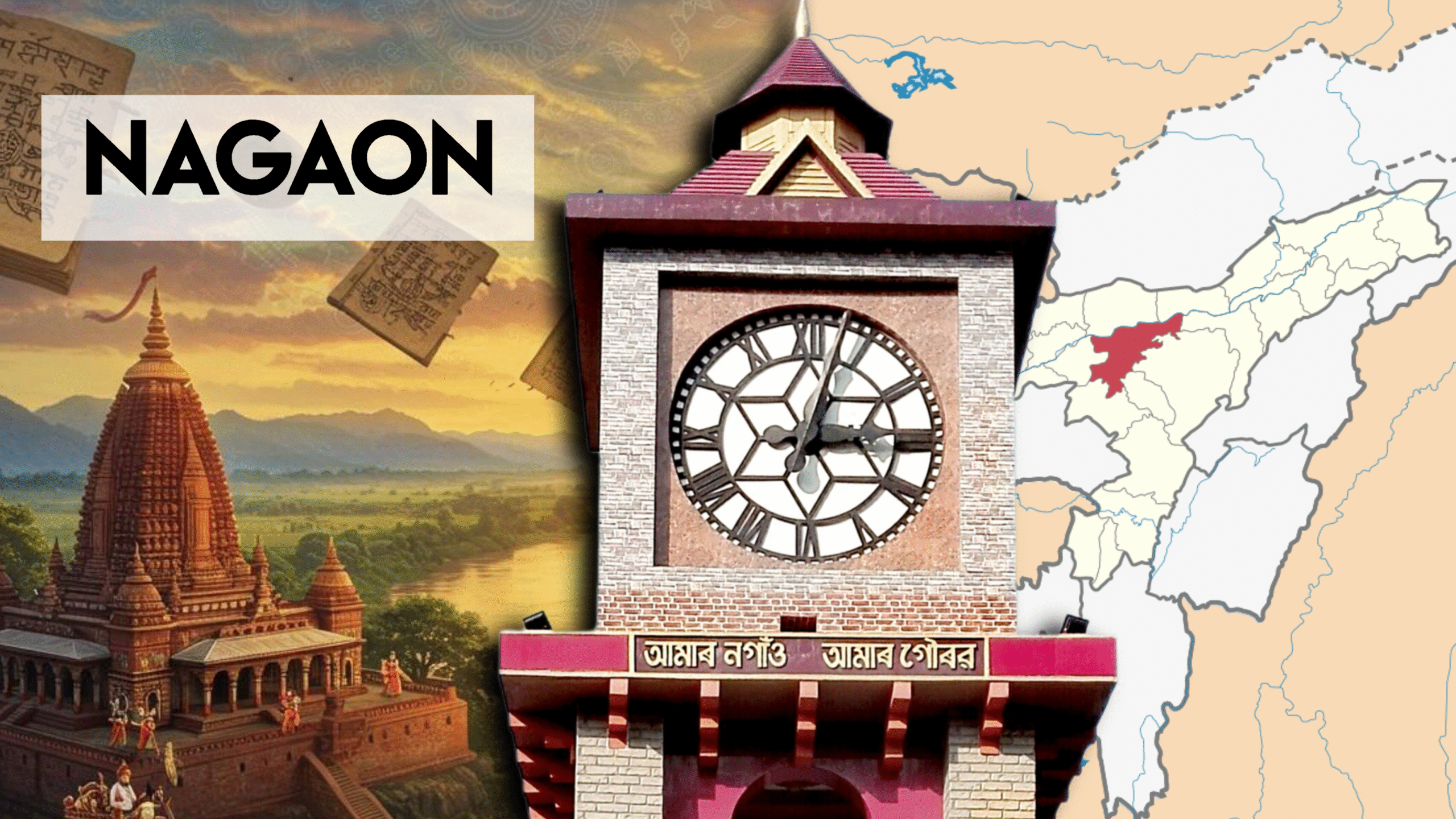
Nagaon, located in the heart of Assam, has a rich past that stretches back to the days
of the Kamarupa Kingdom. Over time, it became a land of changing rulers due to
constant wars fought between the Muhammadans and the Rais of Kamarupa Kingdom.
The history of Nagaon tells the story of how power change has shaped this region’s rich
history. We will be discussing about Nagaon from the Kamarupa age till the advent of
the Ahoms.
The two copper plate inscriptions of Kamarupa kingdom (specifically of Varman dynasty
and Pala dynasty) found in Nagaon is an evidence that Nagaon was part of the
kamarupa kingdom from the Varman dynasty till the final dynasty to rule the empire.
Nagaon originally belonged to the Davaka kingdom. Nagaon was absorbed into the
Kamarupa kingdom when Kalyanavarman (4 th ruler of the Varman dynasty, ruling from
422-446 A.D) expanded his kingdom till the Kapili valley by defeating the Davakas. This
event probably happened around 428 A.D because Kalyanavarman sent a diplomatic
mission to China to signalize his victory in the same year. Since then, Nagaon remained
part of the Kamarupa kingdom. The copper plate inscription of Harjjaravarman (12 th ruler
of Mlechchha dynasty, ruling from 815-832 A.D) indicates that Kapili valley belonged to
the Mlechchha dynasty after the fall of Varman dynasty. After the fall of the Mlechchhas,
the Pala dynasty continued to rule the Kamarupa kingdom. Pala dynasty’s capital was
located somewhere near Nagaon.
In 1226 A.D, Iwaz Khalji (Governer of Bengal, during his second governership in 1212-
1227 A.D) came to Assam and fought Raja Prithu of Kamarupa. Nagaon and Darrang
was captured by the forces of Iwaz. Although Iwaz was later defeated in 1227 A.D by
Raja Prithu. Iwaz’s successor in Bengal’s governership was Nasiruddin Mahmud Shah
(the son of Shamsuddin Iltutmish, the 3 rd Mamluk Sultan of Delhi). Iwaz had betrayed
the Delhi sultanate and had created his own empire in Bengal. Nasiruddin fought Iwaz
and subsequently killed him. In 1228 A.D, Nasiruddin and his Turkish army defeated
Raja Prithu and annexed Kamarupa till Nagaon. Eventually, Raja Prithu was killed by
Nasiruddin and he became the ruler of Kamarupa. After Nasiruddin died in 1229 A.D,
the son of Prithu, overthrew the Turkish forces and ascended to the throne. Later when
Kamarupa kingdom fell, Nagaon was split by the Kacharis (Barahi dynasty) and the
Jaintias. Some part of Nagaon still belonged to the Bengali muslims even after Delhi
sultanate’s forces had left Kamarupa. These Bengali muslims split the territory into patty
kingdoms/chieftains. Hence forming, the Baro-Bhuyan (also known as Borbhuyan).
While the Baro-Bhuyans ruled their territory without any conflicts, Kacharis and Jaintias
remained unstable as they would fight against each other at Nagaon. By 1228, Ahom
Kingdom had begun Its rule over the territory of Upper Assam. Some though theorise
that Sukaphaa, the first Swargadeo (emperor) of Ahom Kingdom did come to Nagaon,
but its only a mere saying without any written record. The ahoms didn’t rule Nagaon
then, but it only happened during the rule of emperor Suhungmung (also known as
Dihingia Roja), that Ahoms fought against Chutias, Jaintias and Kacharis inorder to
become the ultimate rulers of the Northeastern land. During this era, Ahoms had
annexed Nagaon into their kingdom.