Remembering My Grandfather, Hiteswar Saikia: A Legacy for Assam and India
Divyani Saikia
Today marks a special day, the birth anniversary of a man who led Assam with an iron hand and a straight face. Yet, if one looked closely, his back bore the arrows of personal loss and sacrifice, all endured for his love for the people of Assam.
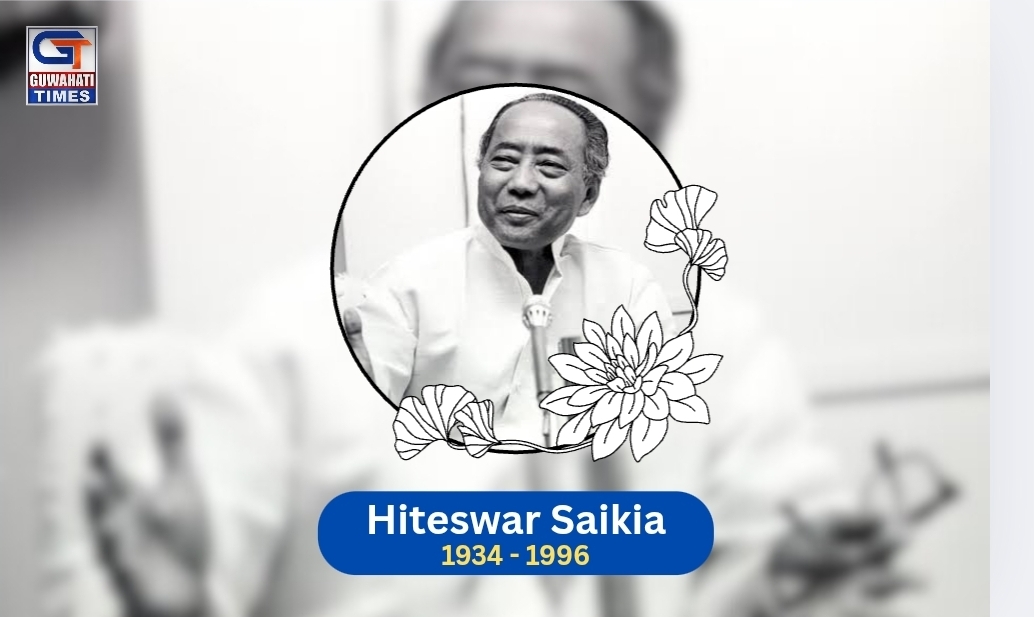
For the world, he is Hiteswar Saikia (3 October 1934 – 22 April 1996), twice Chief Minister of Assam, the first Governor of Mizoram, a legislator from Nazira, and one of the tallest leaders from India’s Northeast. For me, he was more than a statesman. He was a changemaker who cared deeply for people with warmth, and personally, my beloved grandfather.
Born just a day after Mahatma Gandhi, my grandfather grew up inspired by Gandhiji’s non-cooperation movement. He even gave up school briefly just to join his movement. That spark of resistance and compassion defined his journey as a leader. Today, as India needs the relevance of Gandhian ideals, I believe we also need to remember the Saikia model, pragmatic, humane, and deeply rooted in the realities of Assam.
Tackling Insurgency
When Assam was rocked by ULFA militancy, my grandfather faced an unenviable task that was to protect sovereignty while saving lives. He responded with a two-pronged approach: firm military action on one hand, and on the other, a humane amnesty and rehabilitation program for surrendered militants (SULFA).
This blend of firmness and forgiveness is still a lesson for today, whether in Manipur’s ongoing crisis or left-wing extremism elsewhere. Security without reconciliation is incomplete; reconciliation without security is fragile. We must also not forget his role as Lt Governor in Mizoram, where he helped oversee the Mizoram Accord as deputed by Rajiv Gandhi, who trusted him as someone who understood the Northeast. In today’s contemporary society, there are hardly any leaders who can be tasked to complete such an exercise.
Negotiating Ethnic Aspirations: The Bodo Movement
The Bodo agitation was another fire he had to walk through. Demands for statehood had turned violent, but instead of ignoring them, he signed the Bodo Accord, creating an Autonomous District Council. It was not just a political compromise; it was recognition of identity within the Indian union. At a time when indigenous cultures worry about being subsumed under majoritarian nationalism in 2025, his model of autonomy within unity offers a roadmap for today in the 20th century.
Healing Divides: Brahmaputra and Barak Valley
My grandfather understood that Assam’s unity was fragile. The historic mistrust between the Brahmaputra and Barak valleys, linguistic, cultural, and political, often derailed development. He consciously discouraged linguistic chauvinism and promoted cooperation. As identity politics once again dominates our state, his vision of dialogue and inclusivity feels more urgent than ever.
Economic Vision: Linking Assam to the Centre
Assam’s economic backwardness weighed heavily on him. His solution was not just state policy but strategic foresight. He backed Dr. Manmohan Singh’s Rajya Sabha candidature from Assam, ensuring that Assam had a voice in Delhi during India’s economic liberalisation. Even today, as frontier states demand special packages and connectivity projects, we see the wisdom of securing strong representation at the Centre.
Defending Assam’s Place in India
Perhaps the greatest challenge he faced was the secessionist sentiment, when radical groups openly questioned if Assam should remain part of India.
My grandfather stood firm. He defended Assam’s place in India not with empty slogans but through action: protecting security, upholding secularism, and ensuring that temples, mosques, and satras received equal respect. In today’s climate of polarisation, his ability to blend national integrity with cultural tolerance feels like a leadership lesson India desperately needs.
A Legacy Beyond Politics
To the public, Hiteswar Saikia was a Chief Minister, a Governor, a legislator. To me, he was a grandfather whose sacrifices were deeply personal, but always for the people he served. His leadership was not about populism or photo opportunities; it was about making difficult choices to keep Assam intact and moving forward.
He faced insurgency, ethnic unrest, economic stagnation, secessionist tendencies and responded with firmness and flexibility. Military action with negotiation. Autonomy within unity. Inclusion across divides. Strategic Centre–State linkages. Secular governance.
As I reflect today, I see his life as a reminder: true leadership is not about pleasing everyone, it is about protecting people, even at personal cost.
My grandfather’s model still provides enduring lessons for India, on insurgencies, on autonomy, on polarization, on federal politics, and on communal harmony.
On his birth anniversary, I do not just remember a leader.
I remember a man who was, and will always remain, Assam’s guardian and my grandfather.