SEVEN-WEEK-OLD ELEPHANT CALF RAJA IS BEING AIRLIFTED TO VANTARA FOR LIFE SAVING CARE
After suffering a fractured thigh bone in Assam, Raja is being flown to Vantara for specialised hospital treatment, the third such airlift in India made possible by Anant Ambani
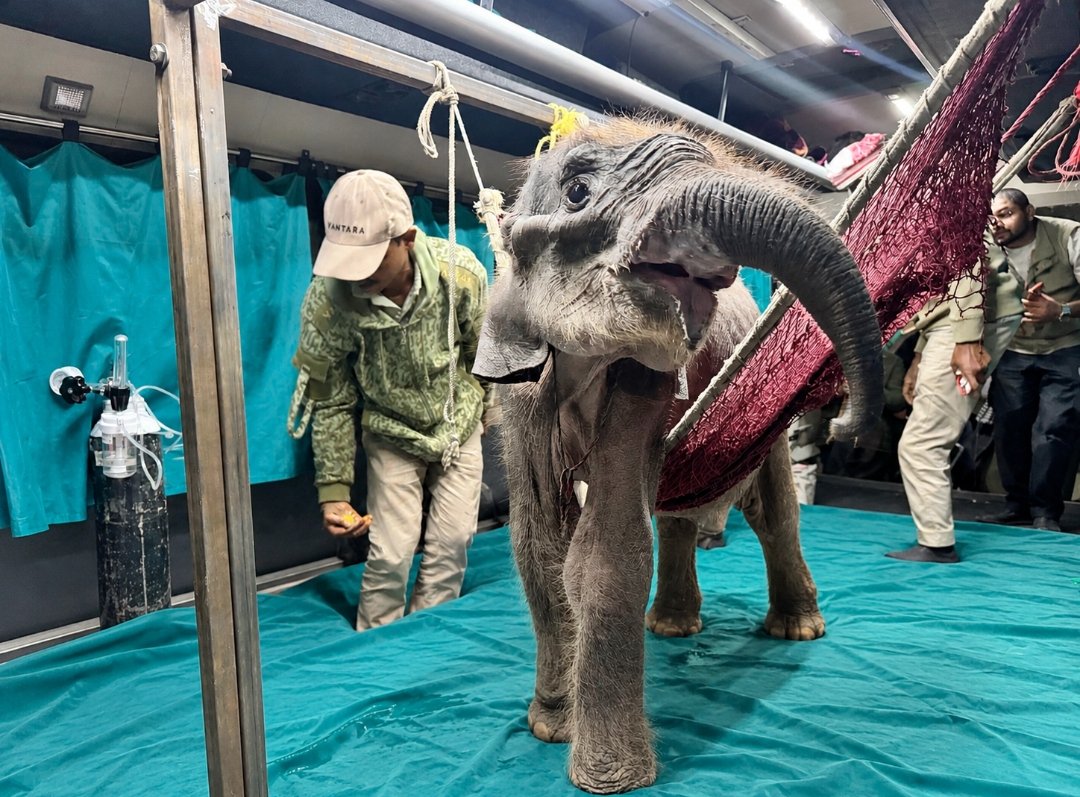
Jamnagar / Guwahati, 20th November 2026: Raja, a seven-week-old Asian elephant calf who has been fighting for his life since the day he was born, is being airlifted from Pohumara in Assam to Vantara in Jamnagar, Gujarat, for emergency hospital care. For seven weeks, the Vantara veterinary team has treated Raja at his owner’s home. His condition has now reached the point where intensive hospitalisation is the only way to give him a real chance at recovery, and a journey by road of more than 2,500 km is not an option for a calf this young and this fragile.
This is the third airlift of its kind in India made possible by Anant Ambani, Founder of Vantara, who has stepped in to ensure that Raja reaches specialised care quickly and safely.
“Raja came into this world with a broken leg, but never a broken spirit. For seven weeks, he has fought with a courage far bigger than his tiny body. Now it is our turn to carry him. With Shri Anant Ambani’s compassion and support, a journey that would take days by road will take just hours by air, and at Vantara, we will give him every chance to stand, to walk, and one day to run.” — Vivaan Karani, CEO, Vantara
A difficult beginning
Raja was born on 2 October 2026 at Gogamukh, Assam. His mother, only 11 years old herself, was young and inexperienced. Frightened and anxious after the birth, she kicked her newborn, and Raja suffered a complete fracture of his right femur, the large thigh bone of his hind leg, on his very first day.
At an age when a calf should be taking his first wobbly steps beside his mother, Raja could not stand or bear weight on his legs. He also could not receive his mother’s colostrum or milk, the first nourishment that gives a newborn elephant immunity and strength.
Seven weeks of care at home
Raja’s owner and caregivers recognised that he needed specialised support, and requested Vantara’s help. The Vantara Rapid Response Team reached him on 8 October 2026.
X rays confirmed a complete overriding fracture, meaning the broken ends of the bone had slipped past each other and out of alignment. The team stabilised the leg with a plaster cast and supportive bandaging, used a sling to help Raja stand and take strain off the injured limb, and started him on a specially formulated milk replacement, along with feeding bottles and guidance for his caregivers.
On 10 October, Raja was moved to his owner’s residence at Pohumara, where the Vantara team has continued treatment, nursing and round the clock monitoring. A hydrotherapy pond was built close to where he rests, to help him move and strengthen his body without placing weight on the fracture.
Why hospitalisation can no longer wait
Without his mother’s milk and unable to move freely, Raja has faced one complication after another. He developed diarrhoea, and laboratory tests found a Klebsiella pneumoniae bacterial infection. He has had recurrent episodes of low blood sugar. Blood tests showed raised liver markers, pointing to stress on his liver. Long hours lying down have caused pressure sores on his head, and he also has an umbilical hernia and generalised weakness.
The team has treated each of these with targeted antibiotics, intravenous fluids, liver support, vitamins and minerals, probiotics, wound care and careful nutrition. But Raja’s condition remains serious. He now needs what can only be provided in a fully equipped hospital: advanced diagnostics, continuous monitoring, specialist orthopaedic care, and a structured nutrition and rehabilitation programme.
The journey
Raja is departing on 20 November 2026 on a specially arranged flight from Guwahati to Jamnagar, a journey of about four hours. He is travelling in a crate designed especially for him, sized to his small body and built to keep his fractured leg stable and supported, lined with deep, soft bedding to cushion him and protect his pressure sores through take off, flight and landing. A dedicated team of Vantara veterinarians, paravets and caregivers is staying by his side for the entire journey, continuously monitoring his heart rate, breathing, temperature, hydration and blood glucose, with fluids, medication and milk feeds ready on board. Moving him by air means hours instead of days in transit, reducing stress and risk for a calf whose body has very little reserve.
What awaits Raja at Vantara
On arrival, Raja will be admitted to Vantara’s elephant hospital, where veterinarians will carry out a full diagnostic assessment and continue pain management, medication, mobility therapy and nutritional rehabilitation. Given the nature of his injury, he is expected to need lifelong veterinary care and monitoring, and Vantara is committed to providing it.