Guwahati’s Drainage Woes Persist as Waterlogging Remains a Major Civic Challenge
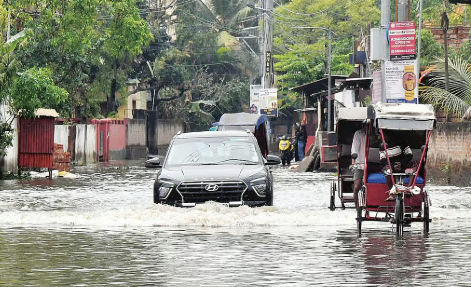
Guwahati’s recurring waterlogging problem continues to remain one of the city’s most pressing civic concerns, with heavy rainfall frequently exposing weaknesses in the urban drainage network.
The city experiences recurrent flooding and severe waterlogging during intense spells of rain, particularly in low-lying areas. The issue has repeatedly disrupted traffic movement, affected residential neighbourhoods and created difficulties for commuters across the city. The Assam government itself identifies recurrent flood inundation and waterlogging during storm events as a major challenge for Guwahati.
Over the years, rapid urbanisation, the loss of natural drainage channels and wetlands, and increasing pressure on existing infrastructure have complicated the city’s drainage situation. Several parts of Guwahati remain vulnerable whenever rainfall exceeds the capacity of local drainage systems.
The government and civic authorities have undertaken several measures aimed at improving drainage and reducing waterlogging. These include drain desiltation, removal of obstructions and projects aimed at strengthening the city’s flood-management infrastructure. The National Highways Authority of India has also undertaken drain desiltation along the Jalukbari-Jorabat stretch ahead of the monsoon.
The challenge, however, goes beyond clearing drains before the monsoon. Experts and residents have repeatedly highlighted the need for a long-term approach that protects natural water channels and wetlands while expanding the city’s drainage capacity.
For Guwahati, the priority remains clear: ensuring that heavy rainfall does not translate into prolonged waterlogging, traffic disruption and hardship for residents.