
Silence Before the Storm
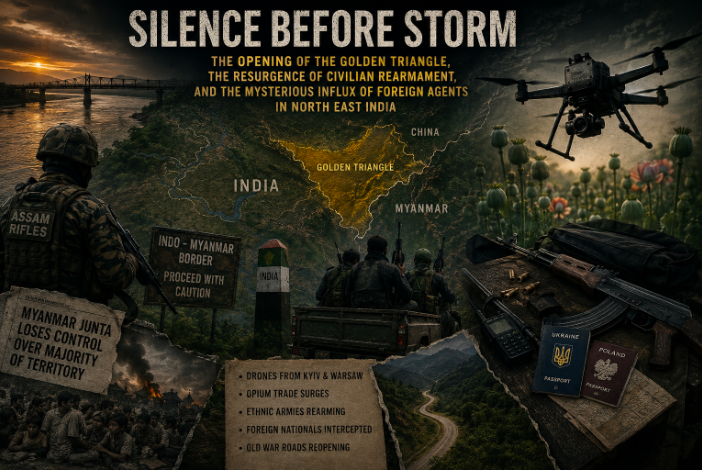
The Opening of the Golden Triangle, the Resurgence of Civilian Rearmament, and the Mysterious Influx of Foreign Agents in North East India
By Maharnav Bhuyan — Strategic Communication Management, Monash University, Australia. Principal author of Midnight’s Oeuvre & Fabricated Communicative Immortality; former journalist and columnist from Assam.
There is a particular quality to silence in Upper Assam. It is not the absence of sound: the tea gardens
still hum with sickle and static radio, the Brahmaputra still drags its brown weight past Sadiya and
Dibrugarh, the Bihu drums have not stopped. It is the absence of incident. For a decade now, the
districts that once bled under the shadow of the 28th Battalion (Tinsukia, Sivasagar, Golaghat) have
known something close to peace. Militancy, we are told, is a memory. ULFA-I is a rump. Its
commander has not set foot in his own camps for ten years. The story Assam tells itself is one of
insurgency exhausted into irrelevance.
But look east, past the tea estates and the last Assam Rifles checkpoint, into the hills where the state’s
writ has never fully reached, and the picture complicates. Myanmar is disintegrating in slow motion.
Opium is being cultivated at a scale unseen in a decade. Drones sourced in Kyiv and Warsaw are
surfacing in the hands of ethnic armies fighting a junta that no longer controls a fifth of its own country.
Foreign nationals with opaque biographies are being intercepted along footpaths on India’s borders with
unsettling regularity. And a wartime supply road, closed for eighty years, is suddenly being discussed
in Delhi’s strategic circles again, not out of nostalgia but because of what lies buried in the hills it
crosses.
None of these threads, on its own, proves very much. Together, they describe a region rearming itself in
the dark. This is an attempt to lay them side by side.
I. The Vacuum That Made ULFA
To understand why the current moment matters, it helps to remember what happened the last time
Myanmar’s north came apart.
The United Liberation Front of Asom was born in 1979 out of a genuine and still-unresolved grievance: the
sense among Assamese youth that the state’s oil, tea, and land wealth flowed outward while unemployment
and unchecked migration hollowed out the province from within. But grievance alone does not build a
guerrilla army. What transformed ULFA from a students’-union offshoot into one of South Asia’s most
capable insurgencies was geography, specifically the porosity of the hills separating Assam from a Myanmar
that, through the 1980s, was itself fracturing into ethnic fiefdoms beyond Rangoon’s control.
Suppressing insurgency in Assam became an essential element of India’s later “Look East” policy precisely
because that insurgency had, from its infancy, been sustained by cross-border sanctuary. ULFA cadres
trained with the Kachin Independence Army and the Naga underground; camps proliferated across the
Indo-Myanmar-Bangladesh-Bhutan quadrilateral faster than any single government could dismantle them.
The 28th Battalion, the “Kashmir Camp,” was the most lethal expression of that sanctuary system: a force of
over 500 cadres headquartered not in Assam but deep inside eastern Myanmar, funded by extortion, armed
with AK-56s and RPGs, answerable to a leadership that could retreat across a border the Indian state could
not follow.
That entire architecture depended on one condition: that the borderlands of northern Myanmar remain
lawless enough to host it, and porous enough to supply it. For twenty years, counter-insurgency operations
(Bhutan’s 2003 Operation All Clear, sustained Indian Army pressure, Bangladesh’s post-2009 crackdown
under the Awami League) steadily closed those sanctuaries one by one. By the 2020s, ULFA-I had been
reduced to a shadow of the 28th Battalion’s era: a few hundred cadres, an ageing and largely absentee
commander-in-chief, and a recruitment base that, by the account of a 2025 defector, no longer even receives
ideological instruction.
Which is precisely why what is happening in Myanmar right now should concern anyone who has read this
history before.
II. Myanmar’s Second Collapse
Five years after the 2021 coup, the Myanmar junta controls barely a fifth of the country’s territory, with over
five million people displaced and more than fifteen thousand killed in 2025 alone. The prospect of a unified
resistance briefly flickered when the Three Brotherhood Alliance’s Operation 1027 tore through northern
Shan State in 2023, but by 2025 Chinese pressure had forced the return of captured territory, and in March
2026 the alliance effectively fractured when the MNDAA turned its guns on its former ally the TNLA,
seizing the border town of Kutkai in a move analysts read as a realignment toward Beijing.
What has emerged from that fracture is not junta victory but a checkerboard of competing sovereignties. A
new coalition, the Steering Council for the Emergence of a Federal Democratic Union, bringing together the
Chin National Front, the Kachin Independence Army, the Karen National Union and the Karenni National
Progressive Party with the exiled National Unity Government, was announced in March 2026, an attempt to
unify a resistance that had spent years speaking in “two or three voices.” Meanwhile the junta, unable to win
outright, has turned to intensified aerial bombing of civilian infrastructure, including hospitals and schools,
in a strategy of attrition against the population it cannot govern.
This is, in almost every structural sense, a repeat of the conditions that birthed the 28th Battalion: a weak or
absent central authority, ethnic militaries controlling long stretches of the India-facing border, and a war
economy that rewards anyone who can move men, money, or matériel through the hills. The difference is
scale, and the difference is drones.
III. The Road of Ghosts, a Haunting Trail from World War 2
There is a single stretch of asphalt, half-swallowed by jungle for eighty years, that captures this shift better
than any troop map: the Stilwell Road. It was built by dying men: American engineers and conscripted
labourers hacking through malarial hill country at a rate the US Army itself called the toughest assignment it
ever handed its engineers. It has spent most of the decades since as a ghost road, remembered mostly
through crashed wartime aircraft still occasionally surfacing from the undergrowth of Assam, Arunachal
Pradesh, and northern Myanmar. That a corridor built to move armies against Japan should now be stirring
back to life as a route for rare earths, insurgents, and unmarked convoys is the kind of historical irony this
region seems condemned to repeat.
Built between 1942 and 1945 under General Joseph Stilwell to resupply Chiang Kai-shek’s forces against
Japan, the 1,736-kilometre road ran from Ledo in Assam, through Myanmar’s Kachin and Sagaing regions,
into China’s Yunnan province. The Indo-Myanmar stretch has been disused since the war ended, and for
decades New Delhi kept it that way deliberately: the presence of ethnic insurgents along the route, and the
fear that reopening it would simply widen the pipeline for drugs and small arms into the Northeast, made the
road a strategic liability rather than an asset. As recently as the 2010s, Indian military planners explicitly
warned that opening the road “can be adversely used against us during any war with China.”
That calculus is now being revisited, not for trade in the abstract but for what northern Myanmar is sitting
on. India has begun holding talks with the Kachin Independence Army, which controls the terrain, over
access to rare-earth deposits including dysprosium and terbium, minerals essential to EV motors, precision
munitions, and satellite systems, a trade currently dominated by China. In other words: the same collapse of
central authority that makes the road dangerous is what makes it, for the first time in eighty years,
accessible: accessible to Indian officials courting the KIA, accessible to Chinese trade networks realigning
with the MNDAA, and, by the same physics of an unpatrolled border, accessible to whoever else wants to
move through it unseen.
A road that reopens because a state has collapsed is not a peace dividend. It is a symptom.
IV. Golden Triangle & The Manipur Conflict
The clearest evidence of what an ungoverned Myanmar produces is agricultural. The UN’s 2025 opium
survey found that poppy cultivation in Myanmar expanded 17 percent from the previous year to 53,100
hectares, the largest area under cultivation since 2015, cementing the country’s position, in the wake of the
Taliban’s opium ban in Afghanistan, as the world’s leading illicit opium source. The price of a kilogram of
raw opium has more than doubled since 2019, rising from $145 to $329, a market signal that draws exactly
the kind of capital that fuelled ULFA’s own extortion-and-arms economy a generation ago.
The correlation between conflict and cultivation is not coincidental. UNODC’s regional representative has
directly linked the intensification of fighting in Shan and other border states to farmers’ return to poppy as
one of the few reliable livelihoods left to them, and, pointedly for readers on this side of the border, a 2023
UNODC assessment found indications of substantial opium cultivation in Sagaing, directly along
Myanmar’s frontier with India. Shan State’s opiate economy has historically bled sideways into Northeast
India’s own insurgent financing networks; there is no structural reason to assume that a larger opium economy next door produces a smaller one here.
That money finds a ready market in a region already the most heavily armed in India. Assam and its
neighbouring states have always sat at an anomaly in India’s gun-control landscape: even under India’s
generally restrictive licensing regime, the Northeastern states show markedly higher rates of licensed
firearm ownership than most of the country, a pattern rooted in border security concerns, rural
land-protection traditions, and decades of insurgency; licensed guns are only the visible fraction of the
region’s actual arsenal.
Manipur has spent the past three years demonstrating what the invisible fraction looks like once civil order
breaks down entirely. Since ethnic violence erupted in May 2023, roughly 6,000 weapons have been looted
from police armouries and gun shops by militants on both sides of the conflict, of which only a fraction have
been recovered, and nearly a third of the weapons in militant hands were found to be more sophisticated than
anything in the state’s own armoury, assault rifles including M16s and M4A1 carbines sourced from outside
official channels entirely. Manipur is not an isolated ethnic crisis sealed off from the wider Northeast; it is a
live demonstration of how quickly a state’s monopoly on force can collapse once it slips, and of how readily
an under-policed, opium-adjacent frontier supplies the weapons to fill the gap. Layer a resurgent Golden
Triangle arms-and-drugs corridor onto a region already holding this concentration of both licensed and
looted weapons, and the phrase “civilian rearmament” stops being metaphorical.
V. The Mysterious Foreigners
Everything laid out above (the collapsing junta, the record poppy harvest, the reopening ghost road, the
looted armouries of Manipur) is scaffolding. It exists to answer one question honestly: why should a handful
of border arrests matter at all? The answer lies in timing and geography, and in both, this moment rhymes
uncomfortably with the one that produced ULFA in the first place.
Recall the sequence from the 1980s: Myanmar’s north slipping out of Rangoon’s control, ethnic armies
consolidating territory along the frontier, and, arriving into that vacuum almost precisely as it opened,
foreign trainers, arms brokers, and sympathetic intermediaries who furnished a fledgling insurgency with
tradecraft it did not yet possess. ULFA did not invent guerrilla warfare on its own; it was taught, in camps
across a border that nobody was watching closely enough. The insurgency that became the 28th Battalion
was, in its infancy, a beneficiary of exactly the kind of externally supplied expertise that a lawless
borderland makes possible.
Set that history beside what has surfaced in the past four months.
The drone network. On 13 March 2026, the NIA arrested American citizen Matthew Aaron VanDyke
(founder of a Washington-based security consultancy that has provided training to non-state fighters in
Libya and Ukraine), alongside six Ukrainian nationals at airports in Kolkata, Delhi, and Lucknow. The NIA
alleges the group entered India on tourist visas, travelled into Mizoram, a Protected Area Permit zone barred
to foreign travellers, then crossed into Myanmar without authorization, where they trained ethnic armed
groups and smuggled a large consignment of drones sourced from Europe. This is not an allegation of tourism gone wrong. It is a documented, charge-sheeted case of foreign nationals entering India’s most
restricted frontier specifically to deliver modern combat capability to armed groups on the other side.
Investigative reporting has traced the consequences: sources allege one shipment of drones brought down a
Myanmar military aircraft, while Kachin rebels separately used drones to damage an ATR-72 at Myitkyina
airport in February 2026, and, in a detail that underlines how contested this borderland has become for
outside powers and not just insurgents, Indian authorities were reportedly tipped off to the group’s
movements by Russian intelligence, itself monitoring the network amid the wider geopolitical fallout of the
war in Ukraine. Whatever the full truth of the network’s backers, the operational fact is undisputed: foreign
nationals with combat-training expertise used India’s Northeast as a transit corridor into a conflict zone, and
the ethnic armies they trained are described by the NIA’s own filing as having links to insurgent
organisations inside India.
The Nepal border incidents. In July 2026, two more unexplained figures surfaced along a different but
equally porous frontier, and, in the retelling, briefly merged into one story they were not. Jordan Brown, a
36-year-old Californian claiming six years’ service in the US Navy and Special Forces, was intercepted by
the Sashastra Seema Bal roughly 35 metres inside Indian territory attempting to cross into Nepal near
Sonauli, carrying no passport, visa, or identification, with two mobile phones he had reportedly damaged
himself, and whose account of how he entered India has shifted with each retelling, with his claimed military
background still unverified by Indian agencies as of this writing. Days earlier and roughly 350 kilometres
away in Bihar’s East Champaran district, SSB personnel had separately arrested Ukrainian national Oksana
Shevtsova attempting an identical crossing, after discovering her visa had expired in 2022: on the available
facts, an unrelated overstay case, folded into the same “foreign agents” narrative online only because the
nationality and the border happened to match. It is worth being precise about that distinction rather than
letting the two blur, as they did on social media within hours of the arrests.
Here, then, is the pattern worth sitting with, not a proven conspiracy, which the public record does not
support, but a recurrence of conditions. A remote frontier, at the periphery of Indian authority and in the
underbelly of Chinese influence, is once again drawing men who move without passports, without a
consistent story, and without any plausible tourist’s reason to be near a border crossing. One such case has
already been proven, under oath, to involve foreign combat trainers arming ethnic militias with links into
India’s own insurgent networks. The others remain unresolved. But the 1980s taught this region what
happens when unexplained foreigners start arriving in its remotest hills at the exact moment those hills stop
being governed by anyone: it is seldom nothing.
VI. Why “Silence Before the Storm”
Here is the genuinely uncomfortable part: ULFA-I itself is not what it was. Its commander-in-chief has not
visited his own Myanmar camps in over a decade and is reportedly based in China; ideological training of
new recruits has largely ceased; and morale within its remaining bases has collapsed following a series of
drone strikes on its Sagaing headquarters. By every conventional metric, the organisation that ran the 28th
Battalion is dying.
But an insurgency dying of organisational rot is not the same as a region returning to peace: it is a vacancy.
The 1980s taught Assam that vacancies of exactly this kind get filled, and filled quickly, by whoever can
supply arms, sanctuary, and cash fastest across an unwatched border. What has changed since the 1980s is
the sophistication of what is on offer: not just AK-56s smuggled from Kachin armouries, but
European-made attack drones capable of downing aircraft; not a slow trickle of opium revenue, but a
decade-high poppy economy worth up to two billion dollars; not a handful of foreign trainers slipping in on
forged papers, but documented mercenary networks with the operational reach to train ethnic militaries in
modern warfare.
Assam is not currently at war. That is the honest, unglamorous truth beneath the alarm. But the ingredients
that produced its last war (a collapsing neighbour, an unregulated arms and opium economy, and foreign
actors moving unsupervised through its border hills) are all present again, in a more advanced form than
they were the first time. Whether that adds up to storm or false alarm is not yet knowable. It is, at minimum,
no longer a silence worth mistaking for peace.
- This piece draws on open-source reporting current as of July 2026. Several elements, particularly the VanDyke network investigation and the status of ULFA-I’s remaining Myanmar camps, remain active, contested, and subject to revision as agencies release further findings.
“The opinions expressed in this publication belong solely to the author. GUWAHATI TIMES is not responsible for, and does not validate, the accuracy or completeness of any information provided.”