Assam on Edge: A State’s dilemma over Illegal Immigration
By: Himanshu Hatimuria
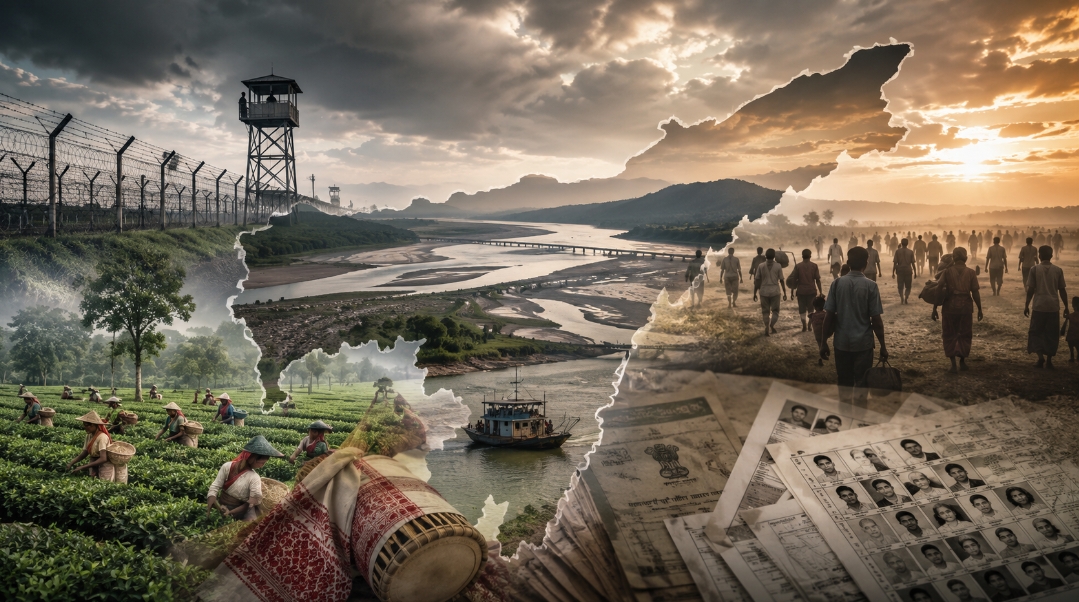
What is the biggest challenge Assam is facing today? Illegal immigration remains at the center of the debate. Assam has long stood at the frontline of India’s most sensitive and enduring disputes, where questions of border security, demographic change and cultural identity converge into a statewide dilemma.
For decades the gaping border with Bangladesh has allowed strings of infiltrators to enter Assam, altering demographics in key districts and raising concerns among indigenous communities in the state. The issue has fuelled political tensions, triggered protests and become a core topic in every election, as Assam grapples on with one significant question of “Who belongs and Who does not?”.
This demographic anxiety is not new; the roots of Assam’s immigration dilemma stretch back decades. After partition in 1947 and the 1971 Bangladesh liberation war, large scale migration from East Bengal reshaped border districts, fuelling the Assam Accord of 1985, which fixed March 24, 1971 as the cutoff date for citizenship. The issue traditionally involved both Hindus and Muslims, but the political discourse has increasingly focused on Muslim immigration, while a major part of the indigenous Assamese viewing it as a threat to their culture, identity or demographic dominance.
Census data has kept this debate alive; in 2001 Assam’s minority population stood at a 30.9 percent, rising to 35.5 percent in 2011. It was noticed that districts bordering Bangladesh such as Dhubri, Goalpara and Barpeta recording the sharpest increases, some crossing 70-80 percent. Over the past decade with continued migration and higher reproductive rate among the particular community, estimates that minority population has risen by around 5 percent as of 2025-2026, although there is no official evidence as the last census was done in 2011. Even so, some political leaders point to differing fertility rates- NFHS-5 data puts Assam’s Hindu Fertility rate at around 1.6, below the replacement level of 2.1, against attributing demographic change to any single cause.
Local indigenous groups have long warned governments that this continued immigration dilutes Assamese culture, language and land rights. In recent years protest have been seen demanding the implementation of the National Registry of Citizens (NRC). Calls have also been made for expulsion of illegal foreigners; and to strengthen and seal the porous Indo-Bangladesh border.
The BJP led govt has been keeping this issue of illegal immigration in top most priority and Chief Minister Himanta Biswa Sarma emphasizing the state’s firm stance against infiltration. But the same time, the cumulative process that were meant to resolve the problem of who belongs and who doesn’t has created a humanitarian crisis of its own.
In the much-demanded NRC which was updated in 2019, nearly 1.9 million people were left out many of whom say they were lifelong Indian citizens but couldn’t provide valid documents due to floods, poverty or simple bureaucratic gaps. Thousands have spent years fighting the foreigner’s tribunal, while others mere rot at detention centres across the state despite having no proven links to Bangladesh. For those families the debate over “who belongs” is not merely abstract but it determines their right to vote, to property and to live with recognition without fear.
This tension between protecting indigenous identity and avoiding the wrongful exclusion of genuine citizens has made Assam’s immigration debate one of the most emotionally charged issue today in the Indian political scenario, with no possible resolution in sight.