How memes contributed to Himanta Biswa Sarma’s historic Assam mandate
By– Ridip Borah
In the 2026 Assam Assembly elections, the road to a historic mandate for Himanta Biswa Sarma was not paved only through rallies, alliances or traditional political messaging. It ran, decisively, through the infinite scroll of smartphones, through memes, reels, viral clips and a relentless digital narrative that shaped perception long before voters reached polling booths.
The Bharatiya Janata Party’s victory, crossing the remarkable mark of 102 seats, was not just electorally significant; it was structurally unprecedented. Assam’s demographic composition, with a substantial concentration of East Bengal-origin Muslims across several constituencies, has historically made such a sweep extremely difficult. Yet, the BJP managed to break through this structural ceiling, winning tightly contested seats, including those with significant Muslim populations such as Hajo-Sualkuchi and Bilasipara.
This outcome cannot be understood without examining the role of digital ecosystems, particularly memes and micro-content, in driving near-total political polarisation and, consequently, consolidation of Hindu votes. In a state where identity politics has always been a latent force, the difference in 2026 was its saturation across “each and every smartphone.” The meme became not just a tool of humour, but a vehicle of ideological reinforcement.
The Meme as Political Weapon
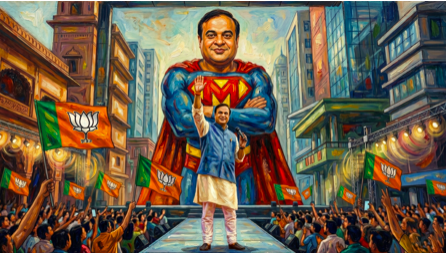
Unlike conventional propaganda, memes work subtly. They are repetitive, easily digestible, and emotionally charged. In Assam’s election cycle, pro-BJP digital networks weaponised this format with remarkable precision. A constant stream of memes portrayed Sarma as “Mama” and “SuperMama,” a protector figure who combined administrative authority with cultural guardianship. This branding was not incidental; it was carefully cultivated across platforms like Facebook, Instagram, and X.
Parallelly, the opposition, particularly the Indian National Congress, was subjected to an equally consistent negative framing. Leaders like Gaurav Gogoi were not just criticised politically but rebranded through digital shorthand. The nickname “Paijaan,” amplified across posts and comment sections, became a recurring label that carried insinuations of cultural and political “otherness.”
What made this strategy potent was not any single viral post, but the cumulative effect of thousands of such interactions. Under nearly every social media post by opposition leaders, one could find a flood of comments repeating phrases like “Paijaan” or “Miya lover.” Over time, this created a subconscious association, embedding the idea that the Congress was aligned primarily with minority interests.
In the digital age, repetition is reality. And in Assam, repetition became political truth. Out of the 19 Congress MLAs elected this time, 18 come from the minority community. The lone Hindu MLA also won from a minority-dominant constituency.
Learning from Defeat: The 2024 Pivot
The BJP’s digital assertiveness in Assam did not emerge in isolation. It was, in many ways, a response to lessons from the 2024 Indian general election, where the party faced unexpected challenges. Opposition groups had effectively used micro-narrativisation—targeted, issue-specific messaging tailored to different voter segments—to dent the BJP’s image.
One widely discussed example was a doctored video involving Amit Shah, which circulated extensively and created confusion before being countered. The episode highlighted how quickly misinformation, if left unanswered, could influence public perception.
Assam’s 2026 strategy appeared to internalise this lesson. Instead of reacting late, the BJP’s digital machinery moved preemptively. AI-generated visuals, clipped videos and rapid-response content were deployed to shape narratives before they could spiral. Opposition figures were framed not just as political rivals, but as representatives of a broader ideological threat, particularly around illegal immigration and identity politics.
The “Paaijan campaign” targeting Gogoi exemplified this shift. By linking him directly to Pakistan through a mix of allegations, commentary, and visual content, the campaign constructed a narrative that was difficult to dislodge once it gained traction.
From Defensive to Offensive Politics
Traditionally, incumbent governments enter elections on the defensive, answering questions on governance, unemployment, inflation, or policy gaps. Assam flipped this script.
Under Sarma’s leadership, the BJP operated almost entirely on the front foot. Instead of responding to opposition allegations, it was the ruling party that asked the questions, and did so aggressively. The burden of explanation shifted to the opposition.
This was visible not only in speeches but across digital platforms. The Chief Minister’s office, party handles, and individual ministers maintained high levels of online activity, often engaging in sharp, even controversial, messaging. This was a departure from older political communication styles that prioritised caution over confrontation.
In today’s media environment, silence is frequently interpreted as weakness. The BJP’s approach recognised this reality. Whenever an allegation surfaced, the response was immediate: counter-narratives, fact sheets, short videos and press statements circulated within hours. Often, the party transitioned from defence to offence before the opposition could fully articulate its critique.
The result was a narrative asymmetry. While the opposition struggled to establish a coherent message, the BJP dominated the discourse, setting the agenda rather than reacting to it. The opposition never truly grasped the discourse and then moment they seemed to settle in, the BJP IT Cell quickly moved to another one.
Development, But Digitally Amplified
It would, however, be reductive to view the BJP’s victory as purely a product of polarisation. A crucial component of its success lay in how it communicated development.
Schemes such as Orunodoi, housing initiatives under PMAY, healthcare expansion and infrastructure projects were not merely implemented, they were packaged. Every new road, bridge or medical college became digital content. Drone shots of infrastructure projects, reels featuring beneficiaries, infographic breakdowns of welfare schemes, all contributed to a steady stream of positive messaging.
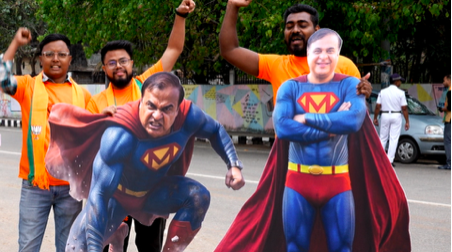
SuperMama life-sized cutouts at Himanta Biswa Sarma’s nomination rally
Handles like “SuperMama” elevated Sarma’s persona into something larger than life, blending governance with myth-making. He was not just an administrator; he was depicted as a Superman reshaping Assam’s future. Such larger-than-life visuals were also visible at his rallies where his supporters carried Superman standees, showing the perfect fructification of digital narratives on the ground.
This dual strategy, identity plus development, proved decisive. Identity politics can mobilise, but it cannot sustain electoral dominance without tangible governance outcomes. By ensuring that development was both experienced and repeatedly seen, the BJP increased its political recall value among voters.
In effect, governance became content, and content reinforced governance.
The New Political Template
The electoral arithmetic of Assam makes the BJP’s 102-seat victory particularly striking. In constituencies with mixed or Muslim-heavy demographics, victories often hinge on narrow margins and fragmented voting patterns.
What the BJP appears to have achieved in 2026 is a high degree of consolidation among Hindu voters. This consolidation was not organic alone; it was digitally cultivated. Constant exposure to narratives around identity, demographic change and political allegiance created a heightened sense of urgency among sections of voters.
Polarisation, in this context, was not just a by-product. It was a strategy. And memes were its most efficient carriers.
By the time votes were counted, it was clear that the BJP had not just won an election; it had demonstrated a model. A model where political communication is continuous, decentralised and digitally native. Where memes are as important as manifestos. Where perception is shaped in real time, not retrospectively.
For parties looking to replicate this success, within Assam or nationally, the lessons are evident:
- Control the narrative early and sustain it relentlessly.
- Combine identity messaging with visible development outcomes.
- Use digital platforms not just for outreach, but for narrative dominance.
- Respond instantly; in the digital age, delay cedes ground.
- Build ecosystems, not just campaigns, networks of influencers, meme pages and micro-handles that operate in coordination.
The 2026 Assam mandate underscores a fundamental shift in Indian politics. Elections are no longer fought only in constituencies; they are fought in timelines, comment sections, and algorithmic feeds.
And in that battlefield, Himanta Biswa Sarma did not just participate, he set the terms of engagement.